
 Leisha
 She is one of my favourite not beause she is a medicine for the physical but because she is a witness to tenacity, beauty and strength….always reaching and bursting her fantastic flower at night.
Moonflower is a luminous night-blooming vine whose large white flowers unfurl from tightly coiled spirals at dusk in one fluid, almost theatrical motion, releasing a soft fragrance that draws moths and other nocturnal pollinators from the dark; by day she appears as a vigorous green climber with heart-shaped leaves and searching tendrils that circle patiently through the air until they find a worthy support.
Below ground her roots participate in a living exchange with fungi and bacteria that mobilize minerals and water to sustain the dramatic evening bloom; each blossom lasts only a single night, glowing like a suspended moon against fence or trellis before folding back into seed and soil by morning, embodying a rhythm of preparation, discernment, and wholehearted opening that feels both ancient and intimate.
f you stand beside her long enough, you begin to understand that what appears still is actually inquiry. The tip of each vine traces a widening spiral, touching wood, brushing wire, assessing texture and stability through living cells that respond instantly to contact.
Moonflower does not simply climb in a straight line toward height as if driven by blind ambition. Her tendrils move in slow, deliberate arcs, circling through air in a gesture that looks almost contemplative.
If you ever have a moment to watch, it is a amazing site to see her reach, find, hold.
When a tendril finds something solid, something capable of bearing her weight, the coil tightens with precision. She commits, wrapping herself around the offered support with elegant strength.
But when she encounters something unsuitable, something too smooth, too weak, too unstable to hold her ascent, she does not waste herself gripping harder. She releases. The spiral loosens. The searching begins again.
That intelligence has always moved me.
A vine that refused to let go would entangle itself in its own persistence. It would pour precious sugars into structures that could never lift it toward light. Instead, she tests, adjusts, redirects.
Her loyalty is not to the first branch she touches but to growth itself.
Years before I came to Ecuador, I was given moonflower seeds as a gift. I planted the first of them in what I once called the Magical Forest, pressing the seed into unfamiliar soil and trusting that something in it would recognize its new home. She climbed anyway, reading the fences, the posts, the trees, deciding where to commit and where to move on.
The plant that grows today is the off shoot of these seeds. Her descendants continue to reach and grow at the Project, exploring new trellises, adapting to new constructions, weaving themselves into spaces that did not exist when I first arrived.
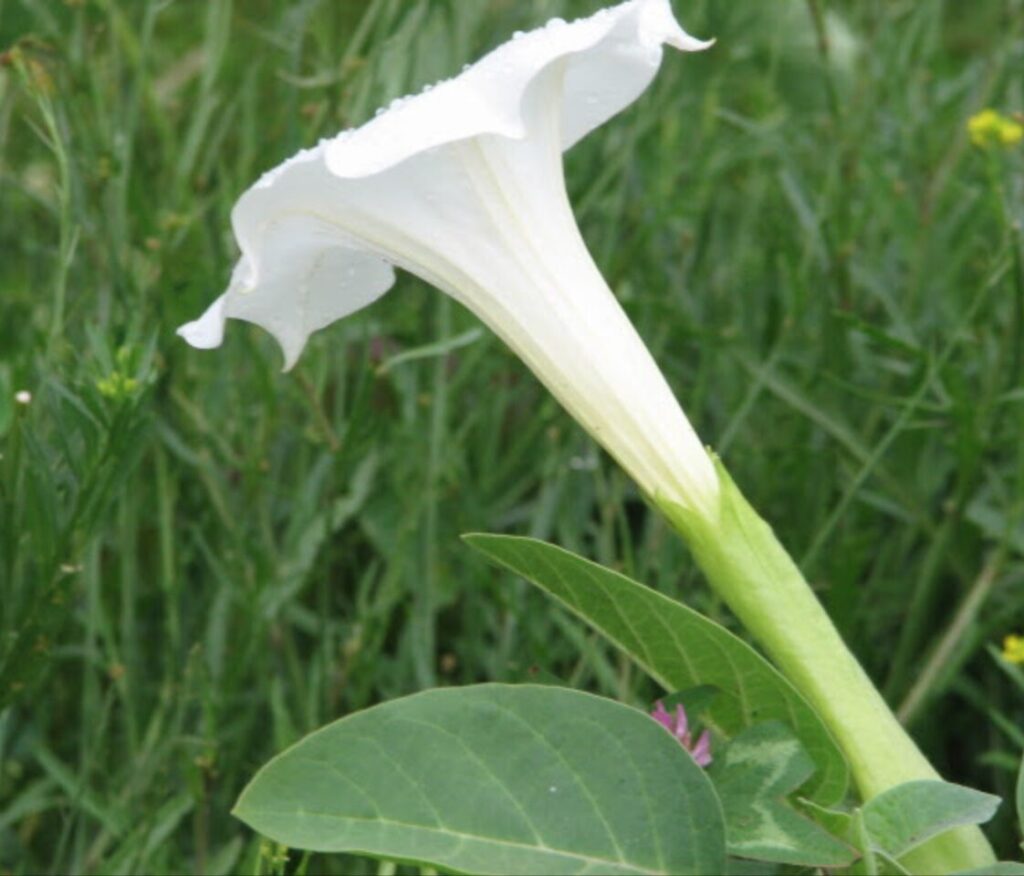
Each generation carries the same quiet discernment in its tendrils and the instant pop of her gorgeous flower at night.
If you observe her in the day you will see the buds have formed like tightly furled spirals holding their energy close. The same intelligence that guides her tendrils is now coiled within the flower itself.
You can see the tension gathered there, a contained architecture waiting for its hour. Then dusk settles over the land, and something extraordinary happens. The spiral that has been holding all day releases fast. Not tentatively, not in fragments, but in one continuous pop and the petals unfurl instantly. The bud is transforms into an instant luminous white bloom that seems to hold moonlight within its own body.
The opening is swift and decisive, the culmination of hours of unseen preparation and countless earlier decisions about where to grip and where to let go.
What I love about her is not only the brilliance of that night bloom but the discernment that makes it possible. She reaches carefully before she commits. She builds wisely before she opens. She releases what cannot carry her, and when the moment is right, she expands completely without hesitation.
Nothing in a living system clings beyond usefulness. Like Moonflower, the Fungal hyphae extend toward carbon and retract when it is gone. Roots proliferate where nutrients flow and withdraw from barren patches. Stability arises from responsiveness, not rigidity.
Moonflower does not confuse persistence with attachment. She is persistent in her ascent, but flexible in her method. She tests the world through her tendrils, and she blooms only when the timing aligns with her rhythm.
Perhaps that is why she remains my favourite.
She teaches that reaching is essential, that release is intelligent, and that true opening requires both. She shows me that growth is not about gripping everything that crosses our path but about discerning what can truly support us, investing energy wisely, and then, when dusk arrives and the hour is right, unfurling into the fullness of who we have been quietly becoming all along.


