Leisha
 One of the most common things I hear from women moving through menopause is the statement that they no longer have hormones or estrogen.
It is usually said with certainty, resignation, and often with the belief that the body has lost something essential and irreversible.
This idea is repeated so often that it has become accepted as fact, yet it does not reflect what is actually happening inside the female body. Menopause is not the disappearance of estrogen. It is a profound shift in how estrogen is produced, routed, and interpreted, and many of the symptoms that arise during this transition have far more to do with signaling confusion than with hormone absence.
A friend of mine asked me for some fig leaves. It was a suggestion from some local ladies. She had been experiencing hot flashes and prepared a simple fig leaf tea, and noticed that the intensity and frequency of the heat dropped quickly.
Well, it caught my attention! I have some very healthy and lovely fig trees that are giving me wonderful figs over the past couple of years. I have been fermenting the ripe figs in alcohol creating a liquore di fichi, a slow-fermented preparation meant to be enjoyed slowly or taken as a digestive. So, are the leaves medicinal?
So, from figs (that look like ovaries) to fig leaves to menopause!
Another important layer in this transition, and one that is rarely discussed, is iron regulation, particularly in the context of estrogen still being present but reorganized.
Before menopause, estrogen production is centered primarily in the ovaries and follows a predictable monthly rhythm that coordinates hormonal, metabolic, and nervous system signaling.
After menopause, that centralized pattern shifts rather than disappears. Estrogen continues to be made, but in a more distributed way, through conversion in fat tissue, adrenal tissue, the brain, the skin, and other peripheral tissues, while overall estrogen balance becomes far more dependent on how effectively it is metabolized, recycled, and interpreted by the body, particularly through the gut and liver.
For most of a woman’s life, menstruation quietly supports iron balance by providing a regular mechanism for iron release. When menstruation ends, that outlet disappears, even though iron intake and absorption often remain unchanged, and iron can begin to accumulate or become poorly distributed.
At the same time, the liver is already taking on a greater role in estrogen metabolism, and iron dysregulation adds additional strain to this system. Excess or poorly managed iron increases oxidative stress and inflammation, which interferes with how estrogen metabolites are processed and experienced by the body, contributing to signaling instability rather than hormone deficiency.
Iron also influences temperature regulation and metabolic heat. When iron is not properly buffered, internal heat perception increases and vascular responses become more reactive, which can intensify hot flashes, especially when combined with shifts in blood sugar regulation and stress hormone signaling. Changes in iron balance also affect the gut environment, shaping microbial activity that participates in estrogen recycling and further influences how present estrogen is interpreted by the body.
Seen this way, menopause is not a state of estrogen loss, but a phase of complex reorganization involving hormone signaling, mineral regulation, metabolism, and detoxification. The end of menstruation removes a regulatory pathway the body relied on for decades, and the systems that replace it require support and adaptation.
Understanding that estrogen is still present, and that symptoms often arise from how it is being handled rather than how much exists, allows for a more grounded and compassionate understanding of this transition and why supporting balance helps the body settle into its new rhythm.
Menopause, then, is not a state of estrogen absence. It is a state of estrogen reorganization. And, a iron dysregulation.
These distinctions matters because many of the symptoms associated with menopause, especially hot flashes, are not the result of deficiency, but of instability or dysregulation. Hot flashes are not caused by “low estrogen” in a simple sense. They are sudden temperature regulation events driven by the brain misreading internal signals and reacting too strongly. Blood vessels dilate rapidly, heat surges upward, sweating follows, and the nervous system is left trying to regain balance.
This overreaction is influenced by blood sugar fluctuations, stress hormone signaling, nervous system tone, inflammatory load, and how estrogen metabolites are being handled and recycled. When these systems are unsettled, the body uses heat as a release mechanism.
This is where my fig leaf research led me down an interesting path.
First, though, about the fig! igs have long been valued for their role in mineral balance, particularly in relation to iron regulation, because they offer nourishment without excess stimulation. Rather than pushing iron levels up or down, figs help the body manage iron more intelligently. They contain a combination of minerals, polyphenols, and soluble fibers that support proper iron binding, storage, and utilization, reducing the likelihood that iron circulates freely in a reactive or inflammatory form.
Figs also support liver function and gentle bile flow, both of which are essential for handling iron safely and for coordinating iron metabolism with hormone processing. In this way, figs act less like a supplement and more like a moderator, helping iron remain useful rather than problematic, which becomes especially important after menstruation ends and the body must rely on internal regulation rather than regular blood loss to maintain balance.
What I discovered about fig leaf is that it does not function by adding estrogen to the body or by attempting to replace hormones that are perceived to be missing. Instead, fig leaf works at the level of signaling, influencing how estrogen is received and interpreted rather than how much is present. Fig leaves contain a range of polyphenols, flavonoids, and plant sterols that interact with estrogen receptors in a modulatory way, meaning they influence receptor behavior without forcing activation or suppression.
Rather than switching receptors on or off, these compounds appear to reduce receptor hypersensitivity, allowing estrogen signals to be read more proportionally and with less volatility. When receptor responsiveness is stabilized in this way, the nervous and vascular systems are less likely to react excessively to normal hormonal fluctuations, which reduces the sudden vasodilation and heat surges that characterize hot flashes.
In effect, fig leaf supports clarity and calm within the signaling network itself, helping the body respond to estrogen more smoothly instead of amplifying minor shifts into disruptive symptoms.
Fig leaf also plays an important role in stabilizing blood sugar, which is one of the most overlooked contributors to hot flashes. When blood sugar drops or spikes, cortisol rises, and cortisol strongly influences temperature perception and vascular response. By smoothing glucose signaling, fig leaf reduces one of the major triggers that turns small internal changes into full heat surges.
Another important piece of this puzzle is the gut. Of course it is!
After menopause, estrogen balance relies heavily on how estrogen is broken down, modified, and recycled, a process that happens largely through the gut and liver. The microbial community plays a central role in determining whether estrogen metabolites are calming and supportive or irritating and inflammatory. When estrogen recycling becomes inefficient or inflammatory, the nervous system responds, and hot flashes often follow.
Fig leaf supports this process by providing fibers and plant compounds that help normalize estrogen handling rather than disrupting it. This is not about suppression or elimination. It is about supporting balance.
I took this a step further by looking at other leaves that naturally support estrogen regulation without pushing hormones in any direction.
Mulberry leaf stood out for its ability to steady blood sugar and reduce cortisol-driven heat, which often sits underneath hot flashes.
Nettle leaf brings in the mineral support needed to calm nerve signaling and soften vascular reactivity, helping the body respond rather than overreact.
Lemon balm helps settle the nervous system so that small internal changes do not immediately trigger a full heat response, while thimbleberry leaf supports vascular tone and smooth muscle stability, reducing the sudden dilation that drives flushing. Thimbleberry is our alternative to raspberries here in Ecuador.
This blend does not force change. It supports steadiness, allowing the body to regulate itself more smoothly instead of being pushed or overridden. I picked everything this morning and into the dehydrator it went. This will be presented in our store tomorrow.
The key point here is that what is often missed in conversations about menopause. Menopause is NOT a deficiency state that needs to be corrected. It is a transition state that requires support while the body adapts to a new way of organizing its signals. The body still has estrogen. What it needs is help interpreting that estrogen clearly and responding to it calmly.
This tea does exactly that.
It does not override physiology or attempt to control the body. It supports the body’s own intelligence as it reorganizes.
Sometimes the most effective answers are not about adding something new or stronger, but about helping the body remember how to work with what it already has.
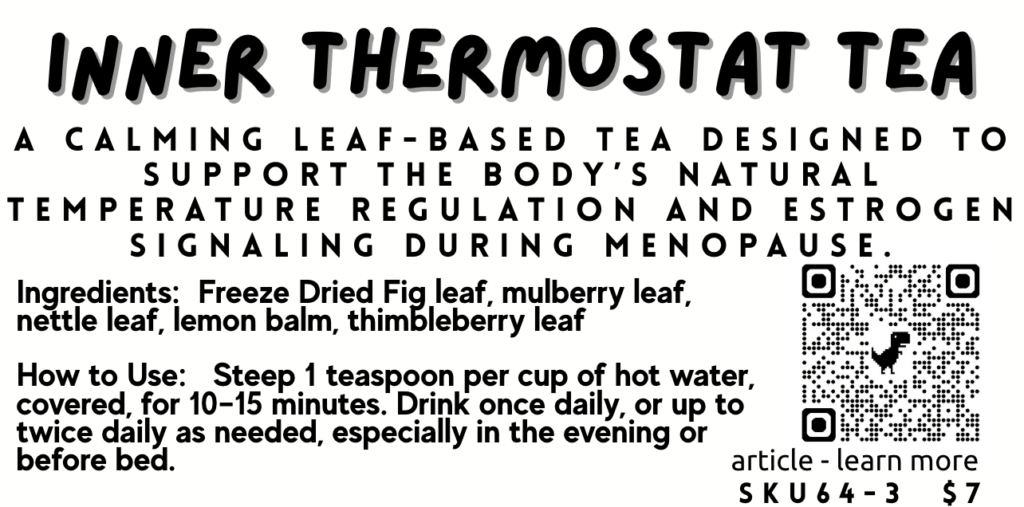
Inner Thermostat Tea
A leaf-based tea crafted from fig leaf, mulberry leaf, nettle, lemon balm, and thimbleberry to support temperature regulation, estrogen signaling, and nervous system calm during menopause. This blend works by stabilizing blood sugar, supporting mineral balance, and helping the body interpret existing estrogen more smoothly, reducing the intensity and frequency of hot flashes without forcing hormonal change. Use: Steep 1 teaspoon per cup of hot water, covered, for 10–15 minutes. Drink once daily, or up to twice daily during periods of increased heat or night flushing. Best taken consistently rather than as a single-use remedy.
https://livinggroundstore.spread.name/product/inner-thermostat-tea