Leisha
 Ashwagandha has become one of the plants I most treasure in our gardens. When I first planted it at my home, I wasn’t sure how well it would take to the Ecuadorian climate, but to my delight it has thrived both in the garden beds of my home and the Project Site of Living Ground .
The plants is not that attractive but stands with a certain quiet strength, their leaves stretching wide to catch the sun, their roots digging deep. Harvesting them is like uncovering a secret treasure because the roots hold the true magic. Thick and pale, they remind me of ginseng, and for good reason. Ashwagandha is often called Indian ginseng, revered for its power to restore strength, energy, and resilience. The tincture turns red.
The name Ashwagandha carries a story. In Sanskrit, ashwa means horse and gandha means smell. Together they form the phrase “the smell of a horse” or more vividly “the virility of a thousand horses.” This isn’t just poetic but a reflection of the vigor, stamina, and life force this plant was believed to impart. Traditional healers saw it as a plant that not only relieved fatigue but infused the body with stamina and the mind with calm clarity. Even today the image of a horse still suits Ashwagandha, a being of both great strength and deep steadiness.
Ashwagandha belongs to a class of plants known as adaptogens, herbs that help the body adapt to stress.
Unlike stimulants, which push the body harder, adaptogens restore balance. Ashwagandha nourishes the adrenals, easing the constant fight or flight mode so many of us live under. It brings steady energy during the day and encourages deeper rest at night.
Ashwagandha’s compounds, called withanolides, are studied for their anti inflammatory, immune modulating, and neuroprotective effects. Modern science has confirmed what Ayurveda has long taught, that Ashwagandha reduces cortisol, supports resilience, and even helps with cognition. It has been studied for its ability to improve athletic performance, to support thyroid balance, to strengthen immunity, and to protect neurons from oxidative stress. The science now catches up with the wisdom that gardeners and healers have carried for thousands of years.
What makes Ashwagandha even more meaningful for me is that we are now about five generations into cultivating it on this land. Each time I grow it, I let plants go to seed, collecting and saving carefully, then sowing again. Because we can grow year-round, the plants are always with us, cycling through growth, flowering, fruiting, and root harvest. Each generation adapts more fully to our soil and climate. They have learned the rhythms of this place, and we in turn have learned their preferences. They are not fussy plants, but they do have a certain dignity.
Ashwagandha likes humus rich, fluffy, loose soil where its roots can stretch and fatten without resistance. It is great in large pots. When the soil is dense or compacted the roots do not form as well, but when the earth is soft and full of organic matter, the roots dig in deep and strong, building their medicine quietly underground. There is something satisfying about loosening the soil with my hands and watching this masculine plant settle into the earth, ready to weave its roots into potency.
I watch the seedlings begin small and tender, then grow into strong, bushy plants that seem to radiate quiet authority. Their small yellow green flowers eventually give way to berries encased in papery husks, but it is always the roots I wait for. Digging is careful work, peeling away the soil until the thick taproots are revealed. They have a horsey scent, earthy and pungent, and in my mind I hear again their Sanskrit name. These roots connect me to all the gardeners before me who have touched the same plant and trusted it to give strength.
Ashwagandha is classified in Ayurveda as a Rasayana herb, one of the great rejuvenators. Rasayana does not just mean to live longer, but to live stronger, with more youthfulness and vitality. To take Ashwagandha over time was to invite the strength of a horse, the stamina of a warrior, and the calm clarity of a sage. Men took it for virility and endurance, but women too turned to it for hormonal balance, recovery after childbirth, and resilience during the cycles of change. It is a herb for all people, for all seasons of life.
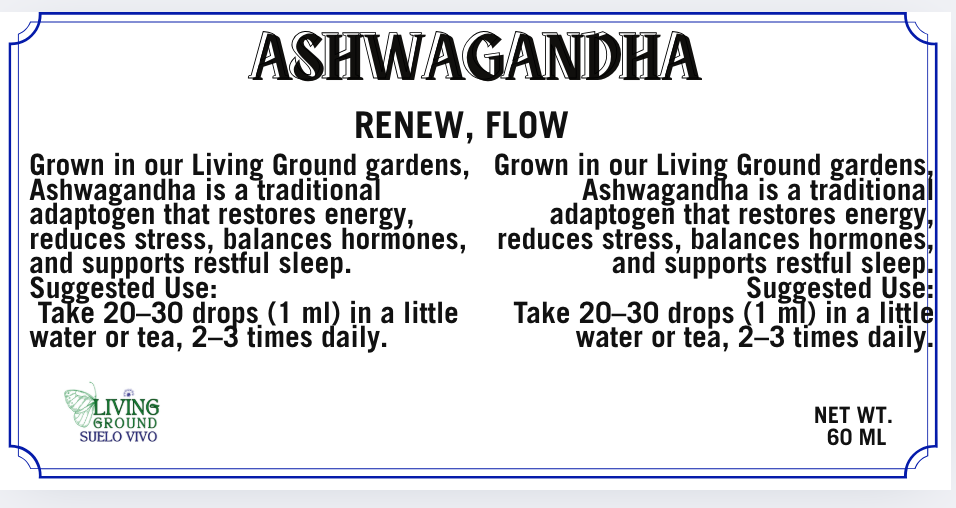
In our apothecary at Living Ground, Ashwagandha is one of the cornerstones. We make tinctures with fresh roots, chopped and macerated in cane alcohol and spring water until their strength infuses fully into liquid. The tincture has a grounding taste, earthy and slightly bitter, but its effects are steady and nourishing. Alone it offers resilience, but it also works beautifully in formulas. In our Brain Tonic it joins other plants to bring clarity, reduce fatigue, and sharpen memory. In immune blends it steadies the body under stress so it does not fall into weakness. It is an herb that plays well with others, generous in how it supports a formula.
What I love most about this plant is its paradox. It gives energy but also helps with sleep. It calms anxiety but does not sedate. It strengthens immunity without overstimulation. It balances hormones without forcing the body in one direction. It is both masculine and gentle, both horse and sage. In a world that constantly pulls us out of balance, Ashwagandha reminds us of what equilibrium feels like.
I often laugh when I dig up the roots, their gnarled shapes carrying both humor and medicine. The smell is strong and earthy, like leather and soil, like the body of a horse that has just run across a field. Visitors to the garden are often surprised that such a revered herb, native to India, grows so well here in Ecuador. They lean down to touch the leaves, to feel the soil, to taste the tincture. We share seeds and plants with those who wish to grow their own, and in this way Ashwagandha’s story continues beyond our fences.
For those who take Ashwagandha for the first time, the effect is rarely immediate. This is not a quick fix plant. Its medicine builds over weeks and months. A few droppers of tincture in water or tea each day begin to work quietly in the background. At first the changes are subtle: a little more energy in the morning, a little less tension in the evening. Then sleep deepens, mood steadies, resilience grows. People find they do not tire as easily, or that stressful situations do not shake them as badly. It is like a quiet friend walking beside you, offering steadying strength that you only notice when you look back and see how far you have come.
In India it is often taken as a warm drink before bed, blended into milk with honey. I sometimes prepare it this way myself, stirred into warm raw milk from our cows, a nourishing ritual that soothes the body before sleep. There is something deeply comforting about it, like being wrapped in a blanket of warmth and vitality at the same time.
Ashwagandha connects me to something ancient and something immediate. Ancient, because it has been revered for thousands of years in Ayurveda as a Rasayana, a plant of rejuvenation, youth, and endurance. Immediate, because I can bend down today, in this very soil, and touch the leaves of a plant that has chosen to thrive here, in my garden, with me. Each harvest ties me to healers and gardeners across time who have trusted this plant to help their people live stronger, calmer, and longer lives.
We are now five generations into growing it at the Project, and I feel this lineage in the seeds I hold in my hands each season. Seeds from plants that have learned to live in this place, that have adapted to our climate, and in doing so have become a part of our story here. Each new planting feels like a conversation across generations, plant and human weaving together resilience.
Ashwagandha has earned its title as the virility of a thousand horses, yet to me it is also the gentleness of a wise elder. It is potent but kind, strong but balancing, grounding but expansive. When I work with it I feel steadier myself, as if the plant lends me some of its rootedness. In every tincture bottle we prepare is not only the chemical compounds of the root but also the story of its growth, its adaptation, and its generosity.
This plant has become a true ally for me and for Living Ground. It gives itself freely, root and spirit alike, asking only that we tend the soil well and keep sharing its gifts. For those who come to know it, Ashwagandha offers more than medicine. It offers a way of being in the world that is calm, steady, and strong, like a horse that carries you tirelessly forward, like a sage who reminds you to breathe, like the earth itself offering balance in a time of imbalance. It is my joy to grow it, to harvest it, and to share it, so that others too may feel its strength, its calm, and its joy. You can find our tincture, seeds, and other Ashwagandha creations in our store at livingground.art/store.