
 Leisha
 Coffee blossoms are a brief candle of the coffee tree. They open after the first good rains, bright white, breathing out a perfume that sits somewhere between jasmine, citrus, and honeyed vanilla. Inside those petals are the same energetic signatures that move sap through the plant, guide bees to nectar, and set the berries.
When you submerge those blossoms in raw honey, you are catching a narrow season and asking the hive’s pantry to hold it for you. The honey becomes a carrier for the flower’s aromatic terpenes, gentle phenolics, and trace minerals that ride in the nectar. It also concentrates a little of coffee’s neural story, since coffee flowers can contain small traces of the alkaloids and acids that define the bean. The result is not a coffee flavor. It is the breath of the grove when the trees are in bloom.
There is a soil conversation in this jar. Coffee grown in living soil speaks through its flowers. Mycorrhizal threads feed the roots, bacteria cycle nitrogen and make phytohormones, and the tree answers with healthy leaves, abundant blossoms, and nectar richer in sugars and micronutrients. Those same networks shape the bouquet you smell.
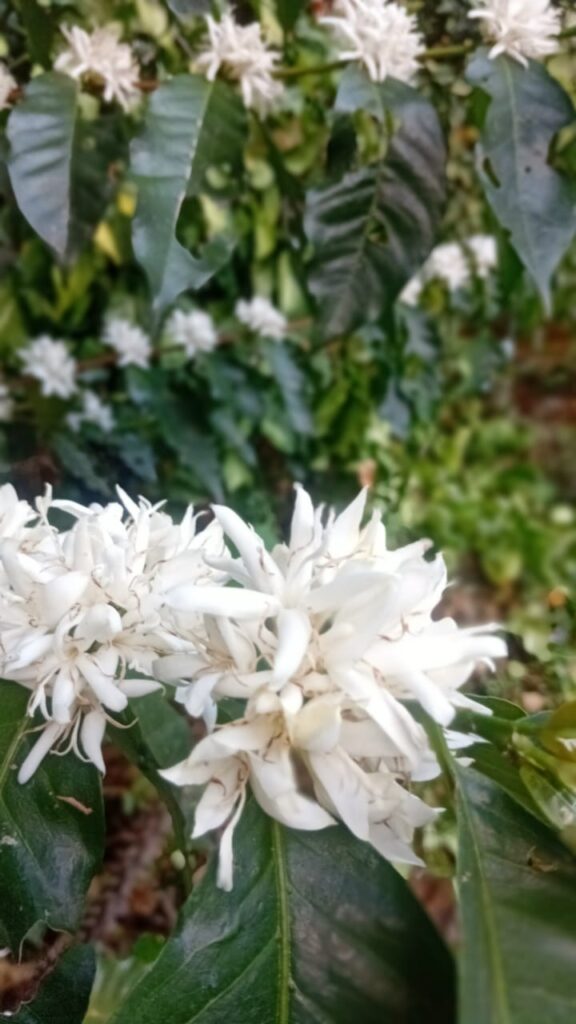
Floral volatiles like linalool, nerolidol, benzyl alcohol, methyl salicylate, and a family of citrusy aldehydes are built from the plant’s primary metabolism and then refined by stress, sun, altitude, and the microbial life at its feet. When the soil food web is active, the plant’s antioxidant machinery is stronger and its phenolic profile is more complex. You taste that complexity when the honey meets the flowers.
On the tongue, coffee flower honey feels light, almost sparkling. The aromatics lift the palate and the phenolic notes give a tiny astringent finish that clears rather than coats. This is why it pairs so well with cultured foods. A spoon over plain yogurt or kefir invites the aromatics to bloom against the tang. Drizzled on fresh cheeses, especially your probiotic curds, it brightens without heavy sweetness.
In warm water with a squeeze of citrus it makes a calming evening cup that feels like the air in a flowering coffee orchard at dusk. Stir a little into a smoothie and the top notes stand out even through fruit and greens. In vinaigrettes, it lends perfume and a round mouthfeel that balances acidity and salt.
From a body perspective, this infusion offers a gentle nudge to the nervous system and digestion. The floral terpenes carry a quieting quality that many people feel in the breath and chest. The phenolic compounds mingle with the raw honey’s natural enzymes and prebiotic sugars to feed beneficial residents in the gut.
Raw honey contains short-chain fructo-oligosaccharides and a spectrum of plant antioxidants that arrive intact when we do not heat it. Marry that with the floral volatiles and you get a small daily tonic that supports microbial diversity by offering both food and friendly signals. Aroma is not just perfume.
Inhaling linalool-rich vapor while tasting the honey engages the vagus through smell, which can soften tension and help the digestive rhythm. A relaxed gut is a welcoming garden for microbes.
There is also a memory thread here. Coffee flowers place a whisper of caffeine into nectar, a signal that helps pollinators return to the tree. In humans, this whisper is far less than a cup of coffee but enough to give focus to the senses when the honey is savored.
The alkaloid story in the flowers is paired with chlorogenic acid derivatives in tiny amounts. Think of it as a gentle brightening rather than a jolt. It harmonizes with the honey’s minerals like potassium and traces of boron and manganese, which the plant pulled from a living soil.
Those minerals matter to plant fertility and they matter to us. Potassium helps cellular fluid balance and muscular rhythm. Boron participates in plant flowering and, in tiny human amounts from foods, has roles in enzyme systems and bone metabolism. The whole arc from soil to flower to honey gathers in a teaspoon.
Practical notes for making it well. Coffee blossoms are delicate and loose their scent and potential when dried. Harvest freshly opened flowers on a dry morning after the dew has lifted. Place into a jar and pour in the honey.
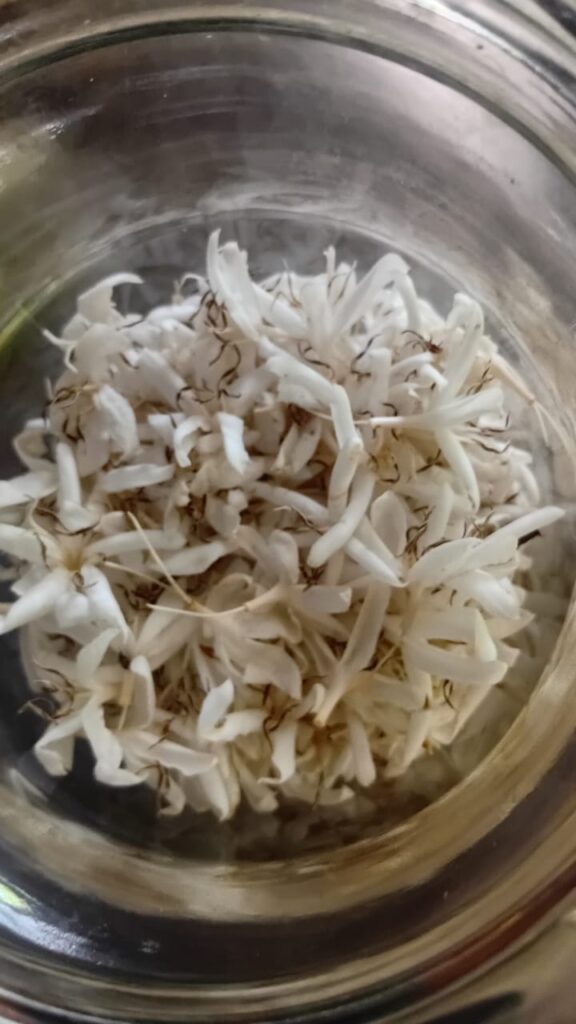
This step concentrates aroma a. Pack a sterilized jar loosely halfway with the blossoms and pour raw, local honey to the top. Use a chopstick to release trapped air. Cap loosely for the first day, then seal. Turn the jar daily for a week and store it in a cool, dark place for four to six weeks.
Strain through a fine mesh or cheesecloth. The spent petals can be folded into granola or pressed into a thin sheet to dry and crumble over fruit.
Burp the jar during the first week, keep it cool, and strain earlier, around two weeks, to capture the bright top notes. Either way, keep it raw. Heat will flatten the perfume you worked to preserve.
Ways to use it in your kitchen and apothecary. Stir a teaspoon into lemon water before meals to wake up appetite and the gentle bitters tucked into the floral matrix. Glaze roasted carrots right after they come from the oven so the honey melts and the aromatics rise with the steam.
Brush over warm cornbread or yucca flatbreads and scatter a pinch of sea salt. Make a simple aperitif by stirring a spoon into cool sparkling water with a ribbon of lime zest. Swirl into whipped cream for strawberries and herbs from the garden.
Drizzle on grilled pineapple, then finish with crushed toasted coffee blossoms if you saved some from the straining. For a quiet bedtime cup, blend with warm water and a few petals of rose or lemon balm. The honey carries the perfume and the herbs hold the body.
Ritual matters. Open the jar and breathe before you taste. The olfactory bouquet is part of the medicine because smell travels straight to the limbic system. Give yourself ten slow breaths with the jar open.
Notice how the chest responds and how the jaw lets go. This softness is not an accident. It is the plant’s way of inviting pollinators and, by grace, it invites us too. In that moment you are also breathing the work of bees who visited many flowers, each carrying microbes from blossom to blossom, shaping the nectar with their bodies, and returning it to the hive.
That movement is one continuous thread from soil microbe to plant to bee to honey to gut microbe. Your jar is a small map of that ecology.
Sourcing and ethics shape the quality. Choose blossoms from trees that live in diverse agroforestry with shade, leaf litter, and compost rather than chemically simplified rows. The richer the forest floor, the brighter and more layered the honey will be.
Harvest lightly. Take a little and leave the rest for fruit set and for the bees. If you keep hives, place them where groundcover flowers also thrive so the bees have options year round.
Feed the soil with composts and ferments, let the leaf litter do its work, and water in pulses that mimic rain. The tree will answer with flowers that sing. You will taste that song.
A simple daily practice. One teaspoon in the morning on an empty stomach with warm water. One teaspoon in the evening straight from the spoon with the eyes closed.
Two points in the day to remember that sweetness can be light and complex, that focus can be soft, and that nourishment is not only macronutrients but also scent, story, and a relationship with the land.
Over weeks, notice digestion, mood, and the way the body responds to floral aromas. Many people report that their breathing slows and that meals feel more grounded when they begin with a floral honey water. Let it be an experiment that you run with your own senses.
In the end, coffee flower honey is a way to store a season and to keep the grove alive in your kitchen. It is a meeting of nectar chemistry, bee craft, and soil intelligence.
It is also a love letter to the invisible workers in the ground who make flowering possible. When you spoon it out, you are tasting rain, altitude, mycelium, leaf litter, bees’ feet, and human care. That is medicine enough.
All of our gourmet and healing honeys are available at our online store


