
 Leisha
 We’re quick to toss what we don’t understand. The skins. The peels. The bitter parts. But sometimes what we discard is exactly what we need to heal.
Pomegranate is a perfect example.
Most people enjoy the juicy seeds, maybe even the juice, and toss the husk into the compost without a second thought. But the outer skin, that thick, astringent peel, holds one of nature’s most potent tools for restoring the gut microbiome. It is not a hammer. It is not an antibiotic. It is something much more intelligent. It works with the terrain, not against it.
In my work with live blood and terrain-based protocols, I’ve seen a pattern again and again. People show signs of microbial imbalance, what we call dysbiosis, but they don’t respond well to harsh protocols. You can’t fight imbalance with more force. You have to shift the terrain gently and steadily in a way the body understands. Pomegranate husk does just that.
Its compounds, including punicalagins, ellagic acid, and tannins, act like gatekeepers. They identify and suppress the overgrowths: Candida, Blastocystis, Giardia, E. coli, Salmonella. They also dismantle biofilms, those sneaky slime shields that pathogens use to hide from your immune system. But here’s the brilliance. While it clears the bad, it actually supports the good. Lactobacilli are left untouched. Bifidobacteria flourish. This is rare, and it is exactly what makes pomegranate husk a tool I return to again and again.
Modern research confirms what traditional medicine always knew. Pomegranate peel has broad-spectrum activity against bacterial pathogens like E. coli, Pseudomonas, Salmonella, and Staphylococcus. It breaks down biofilms and also reduces protozoal organisms like Giardia, Entamoeba, and Blastocystis. It has antifungal activity against multiple Candida species. But unlike antibiotics, it does not wipe the slate clean. It supports key microbial allies, particularly Faecalibacterium prausnitzii, Roseburia, Ruminococcus, and Bifidobacterium. These microbes are essential for producing short-chain fatty acids like acetate and propionate, which feed the gut lining, reduce inflammation, and regulate the immune system.
In one human clinical trial, just four weeks of a standardized pomegranate extract increased levels of Faecalibacterium and Roseburia while raising circulating short-chain fatty acids and urolithins. Urolithins are powerful microbial metabolites derived from ellagitannins. They protect mitochondria, reduce inflammation, and support tissue repair throughout the body. This is terrain restoration in motion. The peel does not just kill what is wrong. It feeds what is right.
So how do we work with this plant? You do not need to buy fancy extracts. You can make your own powder at home. Eat or juice the seeds, rinse the peel, and cut it into strips. Dry it fully in the sun, in a dehydrator, or in a low oven until brittle. Then grind it into powder with a spice grinder or blender. Store it in a glass jar away from light. Start with a quarter teaspoon daily in water, tea, or blended into food. After a week, increase to half a teaspoon if it feels good in your body.
You can also make a tincture. First, soak the dried husk in high-proof alcohol for several weeks to extract the alcohol-soluble compounds. Then simmer a fresh batch in water to pull out the tannins and water-soluble elements. Combine the two extracts and dilute to a final strength of 40 to 50 percent alcohol to create full-spectrum medicine. This method preserves the full intelligence of the plant and makes daily dosing easy and effective.
But clearing is only one part of the process. Once space is made in the gut, we need to rebuild. This is where the garden metaphor becomes real. After using pomegranate to reduce overgrowth and break down biofilms, we need to feed the soil. Resistant starches like cooled potatoes, rice, and green plantains feed the same short-chain fatty acid producing microbes that pomegranate supports. Fermented foods like kefir, sauerkraut, and yogurt reintroduce Lactobacillus and Bifidobacterium. Prebiotic herbs like marshmallow root, slippery elm, yacon, and dandelion nourish the gut lining and help microbes adhere and thrive. Bone broth provides amino acids to rebuild tight junctions. Magnesium, applied through the skin, supports nervous system regulation, hydration, and kidney health. All of these influence the microbiome.
One of my favorite combinations for rebuilding is a simple blend of bee pollen, yogurt, and raw honey. Just a small spoonful daily delivers B vitamins, trace minerals, and beneficial bacteria. It is gentle. It is alive. It works in harmony with the shifts pomegranate creates.
This is not detox. This is not a cleanse. This is repair. It is terrain care. Pomegranate husk clears the way. Food, herbs, and rhythm restore the foundation. The microbiome responds best not to force, but to respect. And when we return to that, the body remembers how to heal.
The next time you open a pomegranate, think twice before tossing the peel. She is medicine. She is soil wisdom. And she has been waiting.
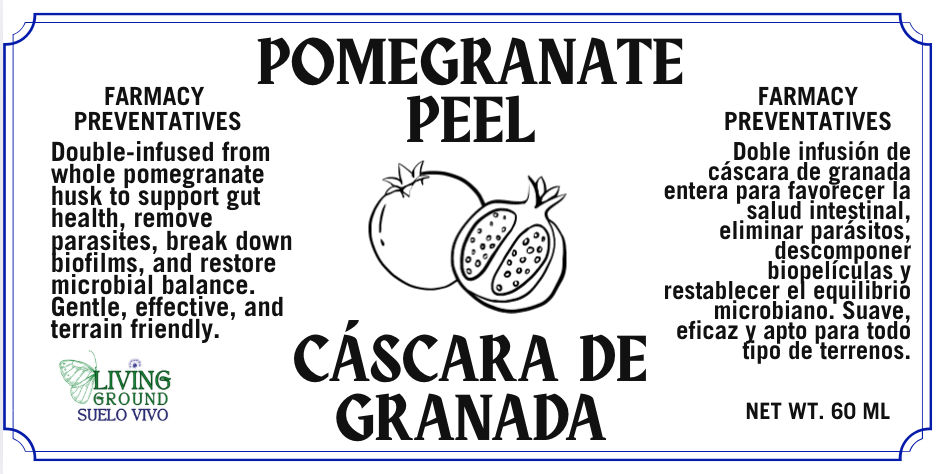
We offer a double-infusion tincture using pomegranate peel. It includes both the water and alcohol extractions to capture the full medicine of the plant. This tincture supports gut balance gently and effectively. To order, visit the Living Ground store.
Sources:
- https://pubmed.ncbi.nlm.nih.gov/38201042/
- https://www.frontiersin.org/articles/10.3389/fnut.2022.887113/full
- https://www.ncbi.nlm.nih.gov/pmc/articles/PMC5993896/
- https://www.longdom.org/open-access/the-efficacy-of-pomegranate-punica-granatum-peel-extract-on-experimentallyinfected-rats-with-blastocystis-spp-2329-8731-1000131.pdf
- https://www.ncbi.nlm.nih.gov/pmc/articles/PMC10182222/
- https://www.sciencedirect.com/science/article/abs/pii/S1075996415300226
- https://onlinelibrary.wiley.com/doi/10.1002/mnfr.202101019
- https://www.mdpi.com/1420-3049/30/7/1634
- https://www.mdpi.com/2077-0383/11/22/6724
- https://www.nature.com/articles/s41598-019-50926-2


