
 Leisha
 Vitamin C is one of those nutrients that has been misunderstood in the modern world.
Most people think of it as ascorbic acid or citric acid, but those are only the shell of something much more complex. They are the empty frame of a living compound that nature designed as a complete system. Yes, they can act as antioxidants, but on their own, they are incomplete and often harsh on the kidneys. This happens because isolated acids alter the pH of the blood and urine, forcing the kidneys to buffer the excess acidity by pulling minerals like calcium, magnesium, and potassium from the bloodstream. Over time, this constant buffering can lead to mineral loss and strain on the kidneys’ filtering structures.
I have known many people whose kidney health was compromised from years of taking isolated Vitamin C or high-dose IV treatments. This includes, unfortunately, my late partner, Jim.
The body recognizes fragments of Vitamin C, but it struggles to use them the way nature intended. When high doses of isolated acids enter the bloodstream, the kidneys must neutralize and flush what the cells cannot absorb. The body does not have the full co-factors to escort or recycle the compound, so the acids accumulate and increase the osmotic load in the kidneys. This overloads kidney function and can irritate the delicate nephrons responsible for filtration.
Real Vitamin C is a full compound. It includes ascorbic acid, but it also holds enzymes, minerals, and plant compounds that work together as co-factors. These co-factors are what make Vitamin C come alive in the body.
I like to compare it to a vehicle. The ascorbic acid is the outer shell of the car, but the co-factors are the steering wheel, the brakes, the lights, and the dashboard that make the car move safely and know where it is going. Without them, you have a shell that looks complete but cannot function. Nature never separates her parts. Every nutrient comes surrounded by a community that helps it do its job properly.
The Vitamin C complex in plants includes compounds like rutin, bioflavonoids, hesperidin, tyrosinase, and minerals such as copper and magnesium. Each one plays a specific role.
- Bioflavonoids help Vitamin C absorb through the intestinal wall and protect it from oxidation.
- Tyrosinase contains copper, which activates Vitamin C for collagen production and connective tissue repair.
- Rutin and hesperidin strengthen capillaries and improve blood flow. Together, they allow Vitamin C to regulate oxidation and repair cells without overwhelming the system.
In the body, Vitamin C behaves like a conductor. It helps enzymes function properly, repairs tissues, supports collagen synthesis, and works with antioxidants like Vitamin E and glutathione to keep cells balanced. When the complete Vitamin C complex is present, the body receives both protection and instruction. When only ascorbic acid is present, it is like taking the steering wheel off the car and trying to drive.
What most people do not realize is that nearly all synthetic Vitamin C on the market today is made in a laboratory, not from plants. It is often produced through fermentation using a genetically modified fungus such as Aspergillus niger or a bacterial culture like Acetobacter suboxydans. These microbes are engineered to convert glucose, usually from corn syrup, into 2-keto-L-gulonic acid, which is then refined into crystalline ascorbic acid. After fermentation, chemical solvents and heat are used to extract and crystallize the product. The end result is pure ascorbic acid – white crystals that look and taste similar to what comes from an orange but without the natural compounds that make it whole.
The body can use a small amount of this isolated form, but without its natural co-factors, it behaves more like a chemical antioxidant than a food-based nutrient. It can neutralize free radicals but does not nourish the cells in the same way.
Because Vitamin C is water-soluble, our bodies cannot store or manufacture it.
Humans, unlike most animals, have lost the gene needed to synthesize Vitamin C in the liver, so we must obtain it daily from food. What we do not use is filtered out through the kidneys and released in the urine.
When we take large amounts of isolated ascorbic or citric acid or intravenous Vitamin C, the kidneys are forced to work overtime, handling an unnatural flood of one compound without the buffers and regulators that nature provides. This strain happens because the kidneys must maintain electrolyte balance and pH stability.
The filtration process demands large amounts of water and minerals to neutralize the acidity and excrete the excess, which can deplete the body of vital electrolytes and fatigue the kidneys over time.
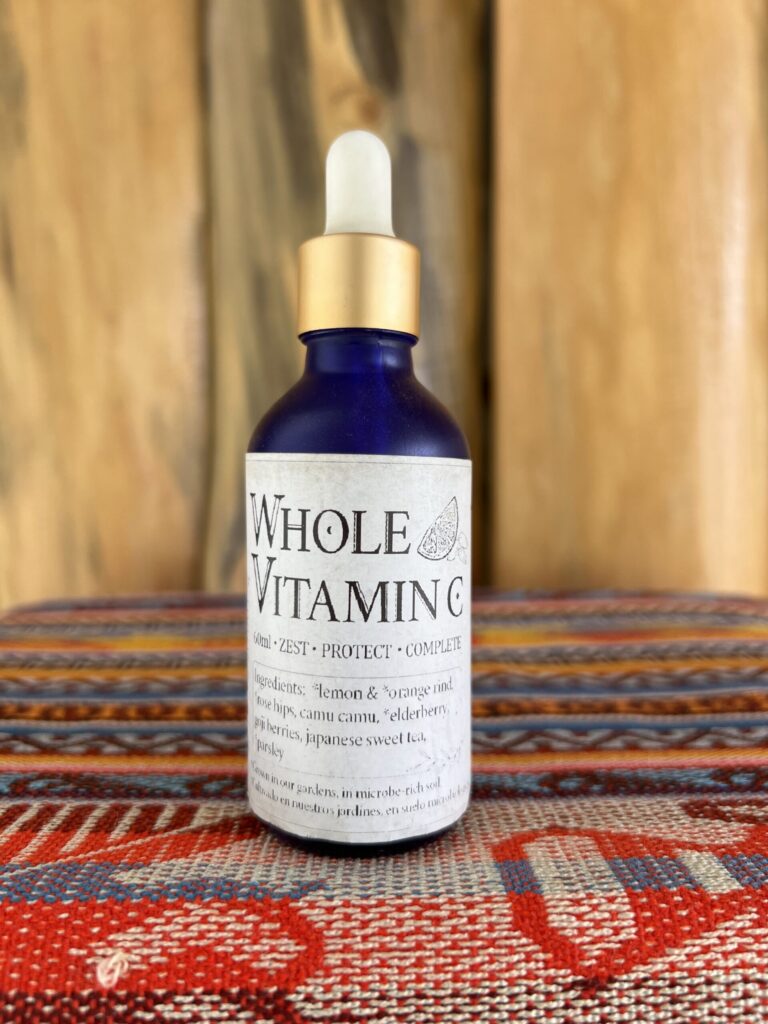
We prepare our Vitamin C powder and tincture from whole plants that carry the complete matrix with orange and lemon skins, camu camu, parsley leaves, and parsley roots.
Each one contributes something unique. Citrus peels are rich in bioflavonoids and essential oils that enhance absorption. Camu camu holds one of the highest concentrations of Vitamin C found in any fruit, and parsley adds chlorophyll, minerals, and enzymes that make the compound complete. The tincture offers a convenient liquid form that preserves these fragile co-factors without heat or processing.
Vitamin C should never be heated, as heat destroys the delicate enzymes and co-factors that make it whole.
The flavor of real Vitamin C from whole plants is bright, tart, and alive. It wakes the tongue and salivary glands and sends a signal through the body that says “fresh.” That taste immediately activates the vagus nerve, which connects the mouth to the brain and the digestive organs. This signal tells the brain that nourishment is arriving and stimulates the release of digestive enzymes and bile.
This is how taste becomes medicine.
Vitamin C touches almost every part of the body. It helps form collagen, the protein that keeps skin, joints, and blood vessels strong. It improves the absorption of iron by reducing it into a form that the cells can use, which is especially important for those who struggle with iron dysregulation or fatigue. It supports adrenal function, helping the body adapt to stress, and it works as a gentle antioxidant, protecting cells from oxidation without blocking the natural signals that the immune system uses to communicate. It also supports the endothelial lining of blood vessels, helping prevent the microtears that lead to inflammation and plaque buildup.
The best way to take Vitamin C is in small, regular doses throughout the day. Because it is water-soluble, it moves through the body quickly. A small spoonful of our whole Vitamin C powder in water or juice two or three times a day keeps levels steady, allowing your body to use what it needs and release the rest gently. The tincture can be taken in a few drops under the tongue or in water throughout the day for a quick, natural boost.
Vitamin C is not just a vitamin. It is a compound of intelligence, designed by nature to work in harmony with life. When we take it in its complete form, from whole plants grown in living soil, it becomes nourishment that strengthens not only the body but the terrain itself. It supports repair, communication, and resilience.
This is the Vitamin C that nature meant for us, the one that builds rather than burns, the one that feeds the garden within.


