Leisha
 There is a plant I was recently introduced too, Laritaco. In botanical language it is known as Vernonanthura patens. It is a shrub with narrow leaves and clusters of soft purple flowers, often growing along roadsides, abandoned fields, and the edges of regenerating forest.
When I first heard about Laritaco, my curiosity was not just about the plant itself. What caught my attention was the family it belongs to.
Laritaco comes from the Asteraceae family, and I have a long relationship with this group of plants. Many of them feel like old friends that traveled with me from the north.
Before coming to Ecuador, plants like yarrow, chamomile, dandelion, calendula, burdock, and echinacea were already part of my landscape. They grew in the fields and gardens of my earlier life and eventually found their way into my work with soil, plants, and health.
When I began exploring the ecosystems here in the Andes, I started noticing something familiar. Different species, different landscapes, different climates, but the same botanical family appearing again and again.
The Aster family seems to follow us across continents.
It is one of the largest plant families on earth, containing more than twenty thousand species. These plants appear in deserts, mountains, tropical forests, meadows, and disturbed landscapes. They are often among the first plants to reclaim soil after disturbance, quietly preparing the ground for more complex ecosystems to return.
Many of them are also deeply medicinal. This is not a coincidence.
Plants in the Asteraceae family evolved powerful chemical defenses to survive in environments full of insects, animals, microbes, and environmental stress. Because they cannot move, their strategy for survival is chemistry.
They produce a remarkable range of compounds including sesquiterpene lactones, flavonoids, polyphenols, and terpenoid molecules. These compounds protect the plant from predators and environmental stress, but they also interact with biological signaling systems in animals. Over time, people began noticing that these plants had effects on the body.
Across cultures and continents, Asteraceae plants appear repeatedly in traditional herbal medicine. Many are used to support digestion, metabolic balance, immune response, and the body’s natural processes of repair.
Laritaco belongs to this same lineage.


What begins to open here, once you move past the language of compounds and pathways, is the way this plant actually lives in the body, not as an isolated chemical, but as a conversation starter.
In tropical regions of Ecuador and across much of Central and South America, Laritaco is not approached as a “targeted” intervention. It is prepared simply, most often as a fresh leaf infusion, sometimes a stronger decoction when the plant is more mature, and taken over a period of days or weeks. The bitterness is not incidental. It is the entry point. That taste on the tongue begins a cascade that moves through digestion, liver function, circulation, and into the broader terrain of the body.
When people drink Laritaco tea, they are not just taking in polyphenols. They are engaging with a plant that nudges multiple systems at once. The bitterness stimulates digestive secretions, supports bile flow, and shifts how nutrients and plant compounds are absorbed and distributed. This is where the language of “cellular signaling” becomes something more lived. The plant is not forcing a change, it is creating conditions where the body can reorganize its own processes.
Traditionally, it is often used in cycles. A cup or two a day, sometimes combined with other local plants, sometimes taken alone to “clear heat,” to support the blood, or to bring the body back into balance after periods of stagnation, heavy food, or environmental stress. In some regions, the fresh leaves are also eaten, lightly cooked or added to broths, which changes the intensity but still carries that signature bitterness into the system.
What is interesting is how this aligns with what is now being studied. The compounds identified in Laritaco, including its polyphenols and unique secondary metabolites, are being observed in relation to oxidative balance and regulatory pathways within cells. These are the same pathways involved in how cells respond to stress, how they communicate with one another, and how they maintain their structure and function over time.
But in practice, this is not about isolating a compound that “acts on abnormal cells.” It is about creating an internal environment where cells are less likely to move into disorganized patterns in the first place. The plant supports the terrain. It supports flow, signaling, and the body’s ability to respond appropriately to stress.
And this is where the deeper layer comes in, the one that connects back to the soil.
Plants like Laritaco are shaped by the microbial life around their roots. The diversity of compounds they produce is not just genetic, it is ecological. The soil organisms, the fungi, the bacteria, the minerals moving through that system all influence the chemistry of the plant. When we take that plant into our bodies, especially in its fresh or minimally processed form, we are not just taking in its chemistry. We are taking in a reflection of that living soil system.
So when Laritaco is used as tea, as food, as a daily bitter, it becomes part of a larger exchange. Soil to plant, plant to human, human back to soil. The same kinds of signaling compounds that help plants respond to stress in the field begin to interact with our own internal ecosystems. The gut microbiome, the lining of the digestive tract, the liver, the blood, all become part of that conversation.
The research language will continue to describe pathways, oxidative balance, and cellular regulation, and that has its place. But in the lived use of this plant, what is really happening is a gentle reorientation. A reminder to the body of how to move, how to communicate, how to stay in relationship with itself.
And it all begins with that bitterness on the tongue, a signal that something active, something alive, has just entered the system and is ready to begin its work.
It is important to understand that plants rarely work through a single mechanism. A plant like Laritaco contains dozens, sometimes hundreds, of compounds interacting with biological systems at the same time. This complexity is part of what makes plant medicine so fascinating.
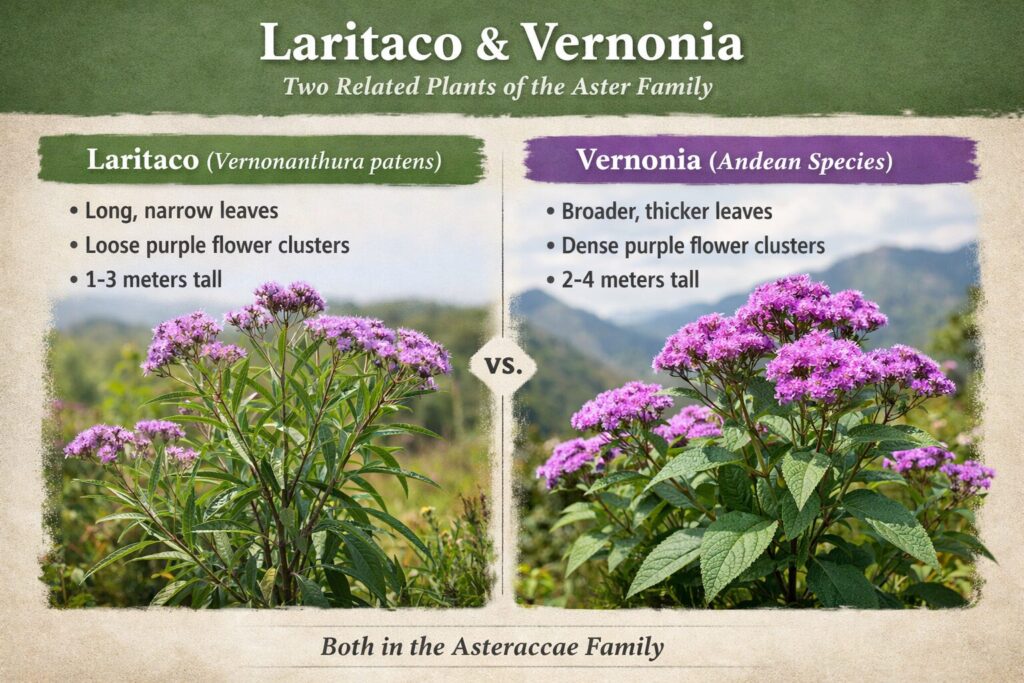
And it brings us to another plant that often enters the conversation that looks similar and is often mis-identified. Vernonia look very similar to Laritaco. Botanically, this makes sense. Laritaco itself was once classified within the Vernonia genus before scientists reorganized the group into several related genera.
These two plants share similar characteristics.
They are shrubs with purple flower clusters, bitter leaves, and a long history of traditional use. Their chemistry overlaps because they evolved within the same botanical lineage.
The interesting thing about plants like these is that their chemistry does not arise in isolation. The compounds they produce are shaped by their relationship with the soil biome.
Roots interact constantly with fungi, bacteria, and other organisms living in the soil. These microbes influence nutrient availability and stimulate the plant to produce defensive compounds. In living soils with diverse microbial communities, plants often produce richer and more complex phytochemical profiles.
The chemistry of the plant becomes an expression of the ecology beneath it. When people consume these plants, their compounds encounter another microbial world inside the human body.
Many plant molecules are transformed by the human microbiome into new compounds that influence metabolism, immune signaling, and cellular communication. In this way, a thread connects the soil beneath our feet to the biological systems inside our bodies.
Living soil shapes plant chemistry.
Plant chemistry interacts with the microbiome.
The microbiome influences human physiology.
This chain of relationships is one of the reasons I am so fascinated by plants like Laritaco and its relatives like Veronia. They remind us that the boundaries between ecology, microbiology, and human health are not separate systems. They are different expressions of the same living network.
Walking through landscapes in Ecuador, I often notice the Aster family appearing quietly in the background. Some are species I already know well. Others are entirely new to me.
Different plants, different places, yet the same botanical lineage appearing again and again, continuing a conversation that stretches from northern meadows to tropical valleys.
Old friends in new landscapes.
And sometimes the plants we think we are discovering have been traveling with us all along.
Note:
Laritaco (Vernonanthura patens) and the plants commonly called Vernonia are closely related shrubs in the Asteraceae family, which is why they often look almost identical at first glance. Both grow as woody shrubs with clusters of soft purple flowers and carry the bitter chemistry typical of many medicinal plants in this lineage. Botanically, Laritaco was once classified within the Vernonia genus before scientists reorganized the group, so the two plants share much of the same evolutionary background and many of the same phytochemical traits. The main differences appear in their physical form and habitat. Laritaco usually has longer, narrower leaves and is more common in tropical lowlands and foothills, while Vernonia species often have broader leaves and are frequently found at higher elevations in the Andes. Despite these distinctions, their similar chemistry and botanical ancestry explain why traditional herbal systems often treat them as related plants with overlapping medicinal roles.