Leisha
 A Love Letter to Place, Soil, and the Foods That Remember
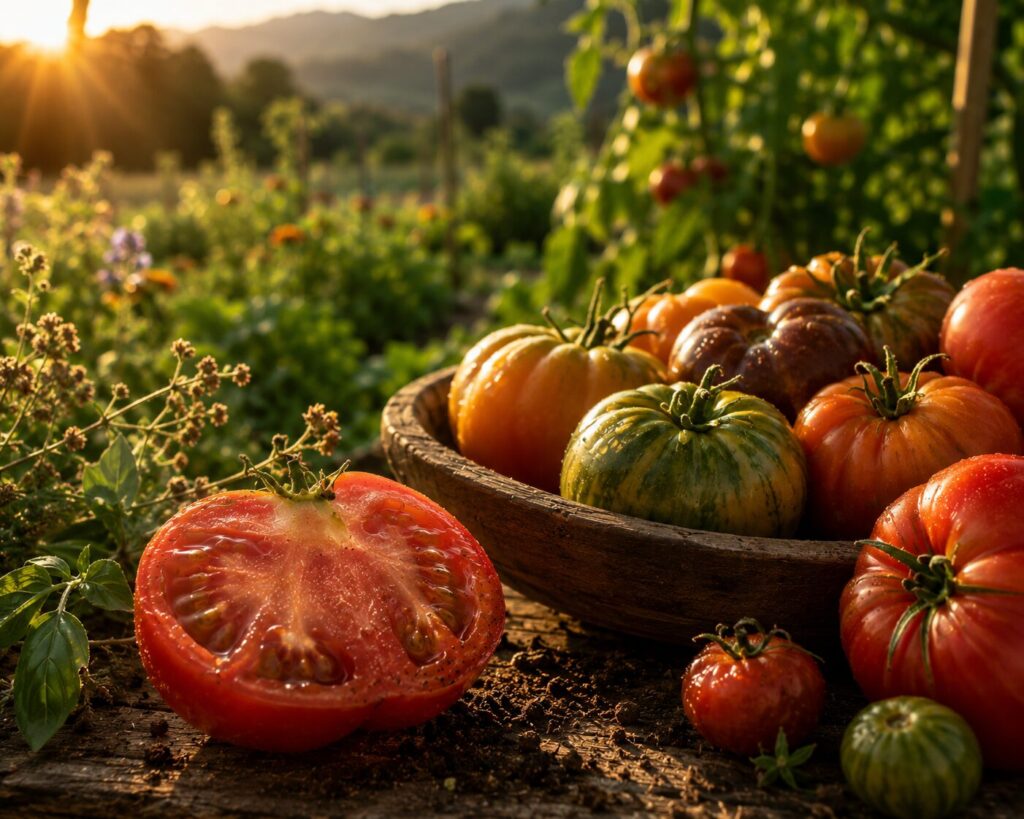
There are moments at the Living Ground Project when I bite into something from the garden and have to stop everything I am doing. Usually, it is a tomato. I stand there in the middle of the garden, juice running down my hand, and think, “This. This is what a tomato is supposed to taste like.” I have been chasing that taste for most of my life.
Not the perfectly round, bright red tomatoes sitting on grocery store shelves, the ones that look beautiful but somehow taste like almost nothing. I mean the tomatoes that stop you in your tracks. The ones that are sweet and acidic at the same time, carrying the warmth of the afternoon sun and the richness of the soil they grew in. The ones that somehow taste alive.
I think many of us are searching for that taste without even realizing it. Maybe it is a tomato your grandfather grew, a strawberry you picked as a child, corn eaten directly from the field, or an orange from a tree in someone’s backyard. Foods that had personality. Foods that tasted like somewhere. I have spent years trying to understand why, and the answer, I believe, lies beneath our feet.
At the Living Ground Project, we spend a lot of time talking about the soil microbiome. We look at compost under microscopes. We teach about bacteria, fungi, protozoa, nematodes, and the entire soil food web. We talk about how living soil creates living plants, but sometimes I think the simplest lesson is this: healthy soil tastes different.
Why does taste change? Because flavor is chemistry, and chemistry is relationship. A plant growing in living soil is not simply taking up nutrients like a machine. It is in constant conversation with the soil food web. The roots release sugars and other compounds into the soil, feeding microbes, and in return those microbes help make minerals and nutrients more available to the plant. This exchange influences how the plant builds sugars, acids, pigments, aromatic compounds, and all the subtle notes that become flavor.
This is why two tomatoes from the same seed can taste completely different when grown in different soil, different weather, or different seasons. One may be watery and flat, while another may be rich, sweet, acidic, earthy, and unforgettable. Taste is not just variety. Taste is soil life, minerals, water, sunlight, stress, ripeness, and timing all coming together inside the fruit. A tomato with real flavor is a living record of the conditions that created it.
And this is also why nutrition changes. A tomato is not only carrying flavor. It is carrying minerals, plant compounds, pigments, acids, enzymes, and the memory of how well it was nourished by the soil. When the soil food web is alive and active, the plant has better access to the elements it needs to build itself fully. Nutrition is not something added at the end. It is grown into the plant through relationship.
This is why I believe taste and nutrition are deeply connected. A tomato that tastes vibrant, complex, and alive is often telling us something about the life that supported it. The color, aroma, texture, and depth of flavor are all clues. They remind us that nourishment is not just about isolated nutrients on a label. It is about the whole living system: the soil, the microbes, the roots, the plant, the harvest, and finally, the human body receiving that food.
The tomato grown in rich, biologically active soil simply does not taste like the tomato grown in tired soil. It cannot, because a tomato is never just a tomato. It is an entire season held inside a single fruit. It is the rain that came late, the cool nights and warm days, the minerals in the ground, the diversity of life beneath the roots, the microbial exchanges happening invisibly in the darkness below, the pollinators visiting flowers, and the sunlight, water, time, and relationships that shaped it.
Every bite is a story. I often think about terroir, a French word usually associated with wine. It means the taste of place, the idea that a wine expresses its soil, climate, geography, and season. But I do not think terroir belongs only to wine. I think a tomato has terroir. I think honey has terroir. I think coffee, herbs, cheese, cacao, and olive oil have terroir. I think medicinal plants certainly do.
I can walk through the gardens at the Project Site and harvest the same herb from different places or different seasons and experience entirely different aromas and flavors. One year may be brighter and more floral. Another year may be deeper and earthier. Neither is wrong. They are simply expressions of time and place, and the same is true for food.
A tomato grown in living soil after a season of balanced rain and warm sunshine carries a completely different expression than one grown under entirely different conditions. That difference is not a defect. It is authenticity. It is evidence that the food still belongs to the earth.
Modern food systems often celebrate consistency. Every tomato should look identical. Every strawberry should be available in every season. Every product should taste exactly the same every single time. But nature does not work that way. Nature has never worked that way. The living world changes constantly, and every harvest tells a different story.
At the Living Ground Project, I think we are trying to remember something humanity has slowly forgotten. Food is not simply calories. Food is information, relationship, memory, and place. Perhaps most importantly, food is alive.
I suspect that part of why so many people feel disconnected from food today is because so much of our food has lost its sense of place. It has become standardized, engineered for transportation, and separated from the landscapes that gave it life. When we eat something grown in living soil, something that still carries the fingerprint of where it came from, something changes in us. We pay attention, slow down, and remember.
I often tell people that I am not really growing vegetables. I am growing soil. The vegetables are simply one expression of that living community. And every once in a while, that community produces a tomato so extraordinary that I stand in the garden smiling to myself, tomato juice running down my hand, completely aware that I am tasting far more than fruit.
I am tasting sunlight, microbes, rain, the season, and this place. Perhaps that is why I keep chasing the taste of a tomato, because every remarkable tomato reminds me that the living world still knows how to make something utterly unique, utterly unrepeatable, and completely honest.
A single bite that tastes exactly like where it came from.