
 Leisha
 Not all medicine grows in our garden. I deeply believe in using what we cultivate and forage here in Ecuador, but some plants are so profoundly restorative to the body’s inner terrain that they are worth bringing in. Slippery elm is one of them.
This is not a tropical tree. Slippery elm, or Ulmus fulva, is native to North America. It grows in cooler climates, often along riverbanks and forest edges. Its inner bark has been used by Indigenous cultures for centuries as both food and medicine. And while the world may know it best for its ability to soothe sore throats or quiet a burning stomach, modern research is now catching up to something deeper. Slippery elm does more than coat. It feeds the microbiome and supports the foundation of gut integrity in a way few plants can.
How Slippery Elm Works
When the powdered inner bark of slippery elm is mixed with cool water, it transforms into a thick, smooth, mucilaginous gel. This gel acts almost like a second skin, coating the inner lining of the digestive tract. Unlike most “gut health” products that work through stimulation or suppression, slippery elm works through buffering, calming, and providing physical support to the tissues.
This coating does not just sit on top of irritation. It allows time for tissues to repair and protects delicate mucous membranes from further damage. In conditions like leaky gut, where the gut lining has become permeable and inflamed, slippery elm acts as a temporary barrier that holds space for healing to occur.
But beyond this mechanical function, slippery elm offers something more remarkable. The mucilage it creates is not just soothing to the human body. It is food for specific families of gut microbes. Research has shown that slippery elm significantly increases populations of butyrate-producing bacteria in the colon. These are not just good microbes. These are foundational to health.
Butyrate is a short-chain fatty acid that serves as the preferred fuel for the cells lining the colon. It reduces inflammation, strengthens tight junctions between gut cells, and regulates immune signaling. In people with gut disorders like ulcerative colitis, Crohn’s, or IBS, butyrate levels are often very low. Feeding the microbes that produce it is one of the most direct ways to restore gut resilience.
In one study, slippery elm increased butyrate-producing bacteria from less than 1 percent to nearly 18 percent of the total microbiota in cultured environments. That kind of shift is not just a supplement effect. That is a terrain-level reset.
So when people say slippery elm is soothing, that is true. But it is not passive. It is not just sitting there doing nothing. It is interacting with microbes. It is helping the body rebuild from the inside out.
Why We Bring It In
Here in Ecuador, slippery elm does not grow. The climate is not right for this tree. But because of its unique properties and its gentle strength, I make a point of sourcing it and making it available to our community. This is one of those plants I trust enough to offer in its powdered form, knowing it can support those who are rebuilding from stress, antibiotics, infection, or chronic inflammation.
It is important to note that slippery elm is not a plant that should be tinctured with alcohol. The mucilage that makes it so valuable is water-soluble, and alcohol would damage or destroy it. For this reason, we offer it in two forms:
- Pure powdered bark in capsules, for ease and convenience
- A glycerin-based extract, for those who prefer a liquid form or want something easy on the stomach
Both preserve the soothing, microbiome-feeding properties of the plant and are suitable for regular use.
Our Soothing Microbiome Blend
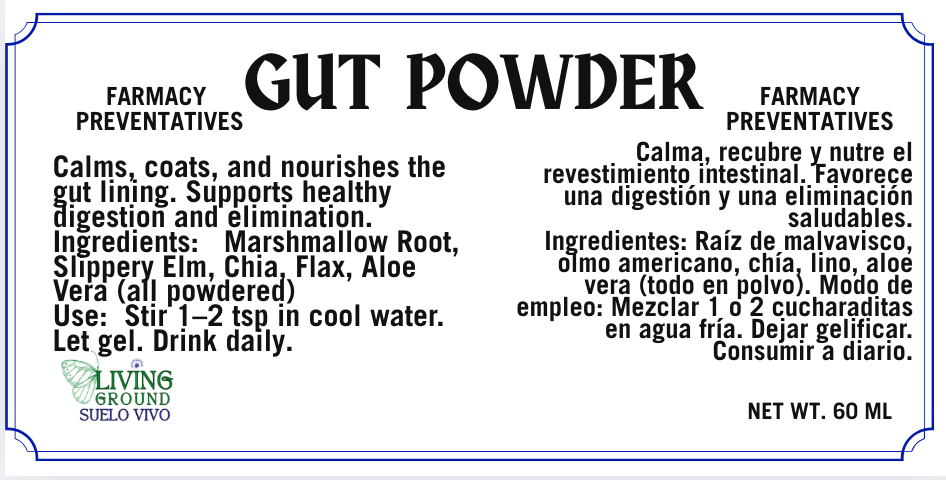
To enhance the power of slippery elm, we also created a powdered blend that brings together several mucilaginous, terrain-healing plants. This is a formula designed to support the gut lining, feed beneficial bacteria, and offer daily repair to a system that has been stretched or inflamed.
Ingredients (all powdered):
Marshmallow Root • Slippery Elm Bark • Chia Seed • Flax Seed • Aloe Vera Leaf
Each of these plants has its own role in the formula. Marshmallow root and slippery elm both coat and nourish. Chia and flax provide mucilage and soluble fiber. Aloe vera brings anti-inflammatory compounds and additional microbial support. Together, they form a soothing, grounding blend that nourishes both you and your microbiome.
Suggested Use:
Mix 1 to 2 teaspoons in cool water and let it sit 5 to 10 minutes until thick. Drink once or twice daily, especially between meals or before bed. You can also add it to smoothies or herbal infusions. It is gentle, neutral in flavor, and easy to incorporate into a daily rhythm.
Storage:
Keep in a cool, dry place. Use within 6 months of opening for best freshness.

The Healing is in the Holding
Slippery elm reminds us that healing does not always require force. Sometimes it requires softening. Sometimes it requires holding space — in this case, literally forming a buffer so that the body can do what it already knows how to do.
It does not disrupt. It does not wipe out. It partners with the gut and its microbes in a way that respects both the biology and the story of healing. This is why I call it a terrain herb. It works from the foundation up.
Whether you are recovering from antibiotics, navigating inflammatory conditions, or simply wanting to support your inner ecology, slippery elm offers quiet, consistent support.
Let me know if you’d like to try the capsules, the glycerite, or the full powder blend. We keep them in stock because once people start using slippery elm, they tend to never want to be without it. It is not a quick fix, but it is a faithful one. And in this world, that is something worth carrying.


