
 Leisha
 I use collagen-rich broth regularly when I am working with microbiome-healing protocols because the gut microbes are only part of the picture. They live against a mucus-covered intestinal lining that has to be hydrated, nourished and continually rebuilt. A good gelatinous broth brings water, minerals and the amino acids from collagen-rich tissues into that process, while the body takes those materials apart and uses them in its own way.
The transformation begins with the parts of the animal that modern kitchens often leave behind: feet, knuckles, skin, joints, cartilage, fascia, tendons and all those chewy bits around the bones. Collagen gives these tissues their strength, water and heat soften that collagen into gelatin, digestion breaks the gelatin into smaller peptides and amino acids, and those pieces become available for the body to use in rebuilding its own tissues. For me, that is the real alchemy of broth. We are taking structure from one living body, transforming it in the pot, transforming it again through digestion, and giving our own body materials it can use while repairing the terrain where the microbiome lives.
Collagen really is a kind of glue. Even its name comes from the Greek word kólla, meaning glue, and humans were making actual glue from boiled animal skin and sinew thousands of years ago. Inside a living body it is doing something far more sophisticated, running through skin, tendons, ligaments, cartilage, joints and the connective tissue wrapped around bone, giving structure and holding everything together.
Look closely at the collagen chain and it gets even better. Glycine, the smallest amino acid, appears roughly every third position, while proline and hydroxyproline help the chains twist into collagen’s tight triple helix. Glycine is small enough to fit into the crowded center where the three strands pack closely together. The glue has architecture, and this tiny amino acid is helping hold the whole arrangement together.
Put feet, knuckles, skin, joints, cartilage, fascia and those chewy tissues into water and heat and the strong collagen structure begins to unwind. It softens into gelatin, which is why a good broth can leave the pot as a liquid and become a delicious wobbling jelly in the refrigerator. What once helped hold an animal together has been rearranged by water, heat and time into something our digestive system can work with much more easily.
For the gut-healing broths I make, those softer tissues around the bone matter enormously. GAPS, the Gut and Psychology/Physiology Syndrome nutritional protocol developed by Dr. Natasha Campbell-McBride, makes a distinction between long-cooked bone broth and the gelatin-rich meat stocks used during the earlier stages of the protocol. Joints, skin, cartilage, feet, necks, ribs, shanks, fascia and meat attached to bone are deliberately included because these are the parts carrying so much connective tissue.
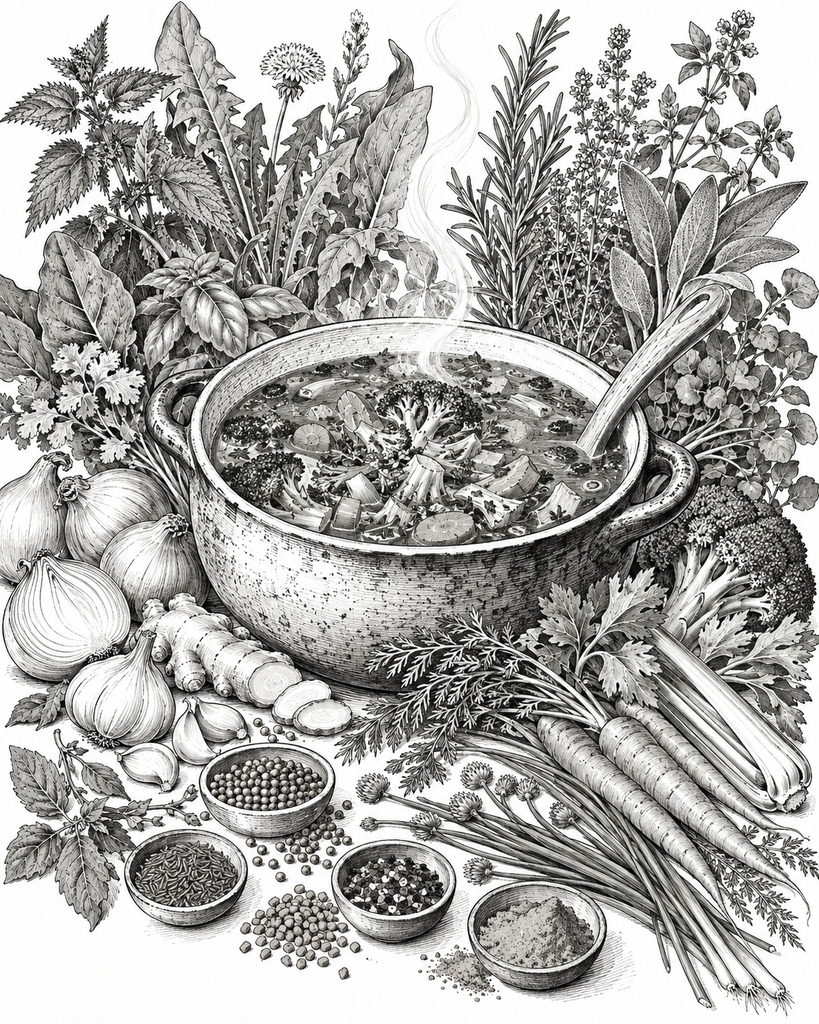
A pot of clean, bare marrow bones can make a good broth, but it will not behave like a pot packed with joints, skin and cartilage. Leave both in the refrigerator overnight and you may see the difference immediately: one still pours while the other needs a spoon. That wobble tells us how much collagen has been transformed into gelatin.
Digestion dismantles the gelatin again. It is broken into smaller peptides and amino acids, including glycine, proline and hydroxyproline, which enter our own pool of building materials. Animal collagen does not travel intact into our knee, intestinal wall or skin. We take it apart, absorb the pieces and use them according to what our own body needs to build and repair.
Glycine has a very busy life once it gets inside us. The body uses it to make glutathione, bile salts, creatine, porphyrins and nucleotides used in DNA and RNA, and it also participates in gastric acid secretion. One tiny amino acid released from a spoonful of gelatin can become involved in digestion, bile chemistry, cellular protection, energy production and tissue rebuilding. That is a remarkable amount of work coming from parts of the animal that are so easily discarded.
Old gelatin research used the wonderfully practical expression “protein sparer.” Researchers observed that when gelatin supplied some of the body’s amino-acid needs, less of the body’s own protein had to be broken down, which became especially important during illness, fasting and periods of poor food intake. Gelatin also appeared to improve the nutritional use of proteins from other foods. In kitchen language, a small amount of meat served with a gelatin-rich broth could nourish differently from the meat eaten by itself.
The old bowl of broth beside the sickbed therefore has more behind it than nostalgia. In 1909, L. E. Hogan wrote about gelatin being retained by very sensitive stomachs and providing nourishment when other foods were difficult to tolerate, while researchers before him had already been experimenting with gelatin during digestive illness. People did not need the words peptides, epithelial cells or microbiome to notice that certain foods behaved differently in a weakened digestive system.
Collagen rebuilding also requires vitamin C. Vitamin C is involved in the enzyme reactions that allow newly formed collagen to become strong and stable, which is why I use whole-food vitamin C alongside collagen-rich broth. At Living Ground we make a powder from dehydrated orange and lemon skins, rose hips, parsley and camu camu, giving us vitamin C within a much larger plant matrix of flavonoids, pigments and other compounds.
I do not boil that powder for hours with the bones. I take it with the broth, with the meal, or stir it into the broth once it has cooled from boiling to comfortably warm. The broth brings amino acids from one direction and the plants bring vitamin C from another, then the body gets on with the chemistry it already knows how to do.
The intestinal lining makes all of this very relevant to microbiome healing. Inside the colon, trillions of microbes may be separated from our internal tissues by mucus and a single layer of epithelial cells. Food, digestive secretions, microbial metabolites and microbes themselves can be sitting only a microscopic distance away from our bloodstream and immune system, so that very thin living boundary has an enormous amount of work to do every day.
Mucus is not simply slime coating the intestine. It holds water, creates physical separation and forms part of the habitat in which the microbiome lives. Gelatin is hydrophilic, meaning it attracts and holds water, which gives us another reason to look at gelatin-rich foods when we are thinking about the condition of that mucus environment.
Chris Kresser, a functional-medicine clinician and ancestral-health educator, has discussed animal research in which dietary gelatin strengthened the mucus layer and altered the composition of the gut microbiota. It was a mouse study, so I would not stretch it into proof of exactly what happens in humans, but the mechanism is worth knowing. It also sits beside a very long history of gelatin-rich foods being used when the digestive tract needed support.
That history goes back much further than I expected. In 1905, Erich Cohn of the Medical Polyclinic at the University of Bonn described gelatin as protective to the intestinal mucous membrane, and later work used concentrated calf’s-foot broth for people with serious intestinal problems. Calf’s feet are packed with skin, tendons, cartilage and connective tissue, exactly the parts that produce a deeply gelatinous broth. The ingredient choice suddenly looks very deliberate.
I use gelatin-rich broths regularly in microbiome-healing protocols and the results I see are consistently positive. Broth is part of a larger rebuilding process involving food, digestion, minerals, mucus, intestinal tissue and the microbial terrain, but it gives the body warm, easy nourishment together with gelatin and amino acids while those tissues are continually renewing themselves. It is a food I return to again and again because it makes biological sense and I see the usefulness of it in practice.
My soil-food-web brain cannot miss the connection. Bacteria, fungi and the rest of the soil food web need moisture, minerals, organic matter, structure, pore spaces, living roots and a steady flow of food through the system. We would not sprinkle microbes onto compacted, depleted ground and expect a thriving soil food web without giving them their habitat back.
Our intestinal microbiome has a ground beneath it too. Mucus, epithelial tissue, water, minerals, food compounds and microbial metabolites create the terrain in which that community lives. Trying to support the microbes while ignoring the lining and mucus underneath them makes no more sense to me than focusing on soil organisms while ignoring the soil they inhabit.
A collagen-rich broth takes structure from one living body and turns it into raw material another body can use. The animal built collagen into skin, joints, tendons and fascia; the pot unwinds it into gelatin; digestion dismantles it again; and our own chemistry decides what to build from those pieces. Some of that rebuilding is happening in the very thin intestinal terrain where our microbial world meets us, which gives the old bowl of broth a very different meaning from simple comfort food.
Here is a previous article I wrote on bone broth including a recipe
We dive into the recipes in the Plant & Kitchen Alchemy Workshop


