
 Leisha
Plant & Kitchen Alchemy · Evening reading, Day 1 of 7
Alchemy Box: written for students of the Plant & Kitchen Alchemy Course. This is the first of seven evening readings written for Plant & Kitchen Alchemy, a seven-day Living Ground workshop on soil, plants, microbes and food as medicine. Each day of the workshop ends with a reading like this one, to take home and sit with overnight, and the next morning begins with what people noticed. You don’t need to have been there to follow along. Each piece stands on its own, and together they trace one thread: from living soil, through the plants and the kitchen, to the community of life within us.
Before you read: here is an invitation
You’ll need a handful of dry compost, or any rich soil with plenty of organic matter in a bag. Open the bag and add a little water, a bit at a time, mixing as you go. You’re aiming for about 50% moisture, the same as when we make compost. The easy test: squeeze a handful hard. It should feel like a wrung-out sponge, with perhaps a drop or two of water and no stream. Close the bag and give it 15 to 30 minutes, or leave it overnight, so the sleeping microbes can wake up.
Now open it, cup it in your hands to warm it, and smell deeply. Then slowly breathe in again.
Stop reading this article for a moment and write answering these questions: What does it smell like? Sweet, mushroomy, like forest floor, wet stone, a cellar, a rainy road? Does it remind you of a place or a person? Does it make you feel anything? Write for five minutes without editing yourself.
After you finish…come back here.
Whatever you wrote, you have just smelled a conversation. That earthy note has a name: geosmin, from the Greek for “earth smell.” It is made by bacteria.
Meet Streptomyces
Streptomyces is a genus of soil bacteria, and one of the most remarkable groups in the soil food web. It belongs to the Actinobacteria, the bacteria that grow in long, branching filaments. Early microbiologists mistook them for fungi, and the name means “twisted fungus.” They form threads, spread through organic matter like a web, and produce spores at the tips of their filaments to travel and survive hard times.
If you’ve seen pale grey or whitish patches, like ash or fine spiderwebs, running through a maturing compost pile, you have very likely seen Actinobacteria at work. They specialise in breaking down the tougher materials that other microbes leave behind, such as cellulose, chitin and woody plant residue. As they grow and sporulate, many Streptomyces release geosmin. When you wet your compost and smelled it deeply, you were smelling a bacterial community waking up.
A nose tuned to earth
Humans can notice geosmin at a few parts per trillion, a pinch of something in an Olympic swimming pool. Nobody knows for certain why our noses are tuned so sharply to it, but there are some good ideas. For our ancestors, the smell of wet soil and rain may have pointed toward water, growing plants and fertile ground. Geosmin also appears in water where bacteria and algae are growing, and it is the reason some fish taste muddy, so a sensitive nose may have helped us judge water and food. These remain hypotheses, but they make a lovely thing to think about while you smell.
An advertisement for springtails
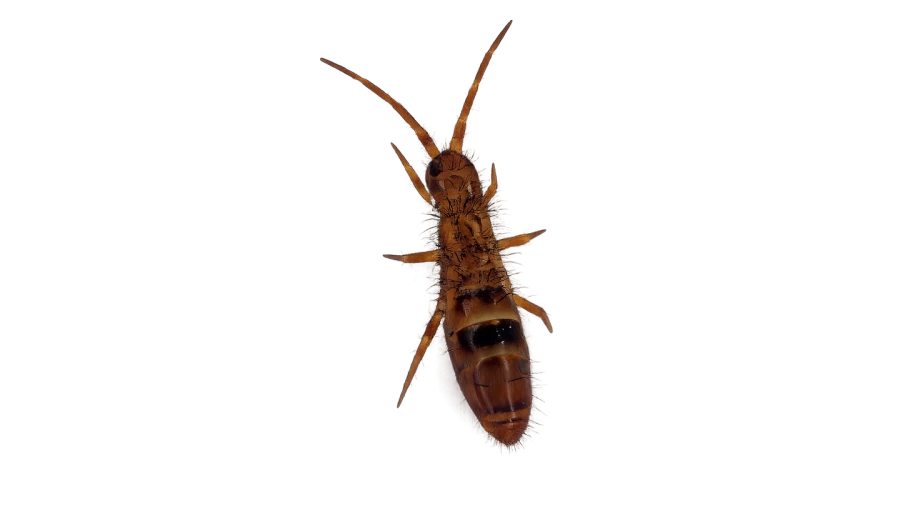
Researchers studying Streptomyces found that springtails are drawn to the volatile scents these bacteria release, geosmin among them.
Springtails are tiny, wingless, six-legged animals, usually only one to five millimetres long. They were once classed as insects and are now placed in their own group, close relatives of insects. Their name comes from a spring-loaded, tail-like structure folded under the body, which they release to catapult themselves away from danger. Healthy soil can hold thousands to hundreds of thousands in a square metre.
In the soil food web, springtails sit in the middle. They are grazers and shredders. They feed on fungal threads, bacteria, spores and bits of decaying organic matter, which fragments material, spreads microbes through the soil and releases nutrients in their droppings. They help keep fungal growth in balance, and they in turn feed predatory mites, beetles, spiders and other small hunters.
When a springtail eats Streptomyces, spores can travel on its body and through its gut and be spread into new places. A scent becomes a way for a microbe that cannot walk to hire a transport service.
The same molecule, a different message
For the fruit fly, geosmin means something else. Researchers found that flies have a dedicated smell circuit for geosmin, and it appears to work as a warning. The microbes that make it, including Streptomyces and certain moulds such as some Penicillium, can produce compounds toxic to developing fly larvae or can compete with the yeasts that larvae feed on. A fly that avoids laying eggs where geosmin is present protects its young. One molecule is an invitation to one creature and an alarm to another.
Why do some people taste it more strongly?
Geosmin is a large part of the earthy flavour of beets, and some people taste far more of it than others. The likely reasons are a mix of genetics and experience. We carry roughly four hundred types of working smell receptors, and the genes for them vary from person to person, so two people can smell the same molecule very differently. Familiarity also matters. If you grew up around gardens, beets or damp soil, that flavour may read as comforting rather than muddy. Flavour is mostly smell, and the amount of geosmin in a beet can differ with variety and growing conditions. Beets are thought to pick it up at least partly from the soil. A splash of lemon juice or vinegar tends to soften the earthiness, because acid helps break geosmin down.
The smell of rain
When rain falls on dry ground, the soil gives off a scent that people everywhere have noticed. In 1964, two Australian scientists, Isabel Joy Bear and Richard Thomas, gave it a name: petrichor, from the Greek petra for stone and ichor, the fluid that flowed in the veins of the gods in Greek myth. They found that during dry spells certain plants release oils that settle into clay-rich soils and rocks, and that rain frees them. Geosmin joins the mix.
Decades later, engineers at MIT filmed raindrops landing on porous surfaces with high-speed cameras. When a drop hits dry soil, it traps tiny air bubbles, which rise and burst like the fizz in a soda and shoot out a fine mist of aerosols carrying the scent, and sometimes microbes, into the air. Light to moderate rain seems to work best, which is why a gentle shower smells stronger than a downpour. The sharp, clean smell that arrives just before a storm is a different thing: ozone, carried down by the storm’s winds.
People have been trying to capture this smell for centuries. In Kannauj, India, perfumers traditionally bake clay and distil its fragrance into sandalwood oil, creating mitti attar, the scent of the first monsoon rain in a bottle.
Now return to your compost
Smell it again, and read what you wrote. Did the smell change after reading? Is there an earthy note you can now pick out from the rest? Add one more sentence to your page.
If your compost smelled sour, sharp like ammonia, or like rotten eggs, that is useful too. It usually means the pile lacked oxygen or was too wet, and different microbes were doing the work.
Later in this course, you will meet geosmin again, not in soil, but in a bottle. Until then, pay attention to the smell of the ground wherever you go. You are smelling a conversation.
Other Interesting Facts
The antibiotic factory under your feet. Soil is crowded, competitive and chemically busy, and Streptomyces are master chemists. A single species can carry the genetic instructions to make dozens of different compounds, including antibiotics, which are used as weapons against competitors and possibly also as signals.
Streptomycin, 1943. In the laboratory of Selman Waksman at Rutgers, Albert Schatz isolated streptomycin from a soil Streptomyces. It was the first effective drug against tuberculosis. Waksman coined the word “antibiotic” and received a Nobel Prize in 1952. Schatz was later recognised as a co-discoverer after a legal dispute over credit.
Ivermectin and a golf course. Satoshi Ōmura found the Streptomyces that produces the precursor of ivermectin in a soil sample taken near a golf course in Japan. The discovery led to a Nobel Prize in 2015, shared with William Campbell, for treating parasitic diseases such as river blindness.
Rapamycin and Easter Island. Rapamycin came from a Streptomyces in soil from Easter Island, known as Rapa Nui, which is where its name comes from. It is now used as an immunosuppressant and is studied in research on ageing.
A large share of our medicine. Soil actinobacteria remain the source of a large share of the antibiotics we use, with Streptomyces the most productive group.
Not every Streptomyces is a friend. A few species cause potato common scab, the rough, corky patches that appear on potato skins and sometimes on beets, carrots and radishes. The culprits make a toxin called thaxtomin that interferes with the way young tubers build their cell walls, and scab tends to be worse in dry, neutral to alkaline soils. The potato is usually fine to eat, but the story is a reminder that in the soil, one genus can hold healers, decomposers and the occasional troublemaker.
Genes that wait for company. A Streptomyces genome can hold the instructions for dozens of compounds, but in a laboratory dish, growing alone with plenty of food, most of those instructions stay silent. Scientists have found that growing Streptomyces alongside other microbes can switch on compounds that never appear when it grows by itself. Competition seems to be one of the triggers. It is also why researchers now try to grow soil microbes in conditions closer to home. In 2015, a team used a device that lets bacteria grow in the soil, in contact with their natural neighbours, and discovered a new antibiotic called teixobactin from a bacterium no one had ever grown in the lab. Some of the most powerful chemistry in the soil seems to wake up only in company, which is another version of the conversation you smelled in your compost.
A friend of the cabbage family
Actinobacteria turn up in a place many gardeners don’t expect: around the roots of the brassicas. Cabbage, broccoli, cauliflower, kale, radish and mustard generally don’t form the arbuscular mycorrhizal partnerships that so many other garden plants rely on. They’ve taken a different path, and their roots still live in rich microbial company. Research on field-grown canola, a close relative of cabbage, found Actinobacteria among the dominant bacterial groups in its root zone, so these thread-like bacteria appear to be among the brassicas’ favourite neighbours.
This has a practical side for the garden. A young, active compost with strong Actinobacterial populations brings a different community to the soil than an old, fungal compost does, and brassicas don’t need us to force a mycorrhizal relationship on them. The compost in your hands may be exactly the kind a cabbage bed enjoys.
It also reaches into the kitchen. The same plant family that keeps company with these soil bacteria in the garden goes on to meet other microbes in the sauerkraut crock, which is a story for later in the course.


