
 Leisha
Here is a question to start with. If you were a taste, which one would you be?
Not the taste you like. The taste you are. Sweet, sour, salty, pungent, bitter or astringent.
Most people want to say sweet, because it sounds like a compliment. But every taste has a gift and a shadow, and the sweet one is rarely the most powerful. By the end of this article you may want to change your answer.
Your tongue is a laboratory
The compounds that give a plant its flavour are very often the same compounds that act in the body. When you taste a plant, you are sampling its chemistry directly, with an instrument that evolved over millions of years to tell us what is food, what is medicine and what is poison.
- Bitterness usually comes from alkaloids, iridoids, sesquiterpene lactones and other bitter compounds. Many of the strongest medicines, and many poisons, are bitter, which is why we are wired to notice it so sharply.
- Astringency comes from tannins, the same compounds that make strong tea, red wine and unripe fruit pucker your mouth.
- Pungency comes from volatile oils and resins, and from compounds such as capsaicin in chilli, gingerols in ginger and the sulphur compounds in garlic and mustard.
- Sourness comes from acids: citric acid in lemons, malic acid in apples, acetic acid in vinegar, lactic acid in ferments.
- Sweetness comes from sugars and starches, the plant’s stored energy.
This is why traditional systems of medicine around the world sorted plants by taste long before anyone could analyse them. In Ayurveda, India’s traditional medicine, the six tastes are called rasa, and every food and herb is described by its taste, whether it is heating or cooling, and what it does after digestion. Traditional Chinese medicine uses five flavours in a similar way. Taste was the laboratory, and it still works remarkably well as a practical guide.


Six tastes, and two that are not really tastes
Modern science recognises five basic tastes, each with its own receptors on the tongue: sweet, sour, salty, bitter and umami, the savoury taste of broth, mushrooms, miso and aged cheese. Umami was identified in 1908 by the Japanese chemist Kikunae Ikeda, who was curious about the deep flavour of kombu seaweed broth.
The traditional six-taste list includes two that have no receptor at all.
Astringency is a physical event. Tannins bind to the proteins in your saliva and make them clump, the slippery film in your mouth breaks down, and the surfaces stop gliding over each other. That dry, rough feeling is friction. The same tannin action is what tightens tissue, which is why astringent herbs have been used for centuries on wounds, sore gums and loose stools.
Pungency has no taste receptor either. Chilli, ginger, garlic and mustard switch on the nerve sensors that report heat and irritation. Capsaicin from chilli triggers the same receptor that responds to real heat, which is why chilli feels hot. Mustard, horseradish and garlic trigger a related sensor that also responds to cold and irritation, which is why wasabi seems to go straight up your nose. It is damage reported without damage done.
The old six-taste system is not wrong. It was built by people paying close attention to what happens in the mouth, and what happens in the mouth turns out to be a reliable guide to what a plant will do further along. It simply drew its lines around experience rather than around receptors.
What each taste does
Sweet builds and nourishes. It was the first taste any of us knew: milk. It signals energy and safety, it satisfies, and it grounds. In Ayurveda it is considered cooling and heavy. Found in grains, roots, ripe fruit, milk and honey. Too much, and it clings: think of how hard it is to stop at one biscuit.
Sour wakes you up. The mouth waters, the eyes squint, and saliva and digestive juices start to flow. Acids also help the body absorb certain minerals. Found in citrus, vinegar, tamarind and all fermented foods. Too much, and it can turn sharp and irritating.
Salty brings minerals and appetite. It makes the mouth water and makes food taste more like itself. In plants it is faint, but you can find it in the ones that gather minerals from the soil: taste a stick of celery, a dandelion leaf or a piece of seaweed.
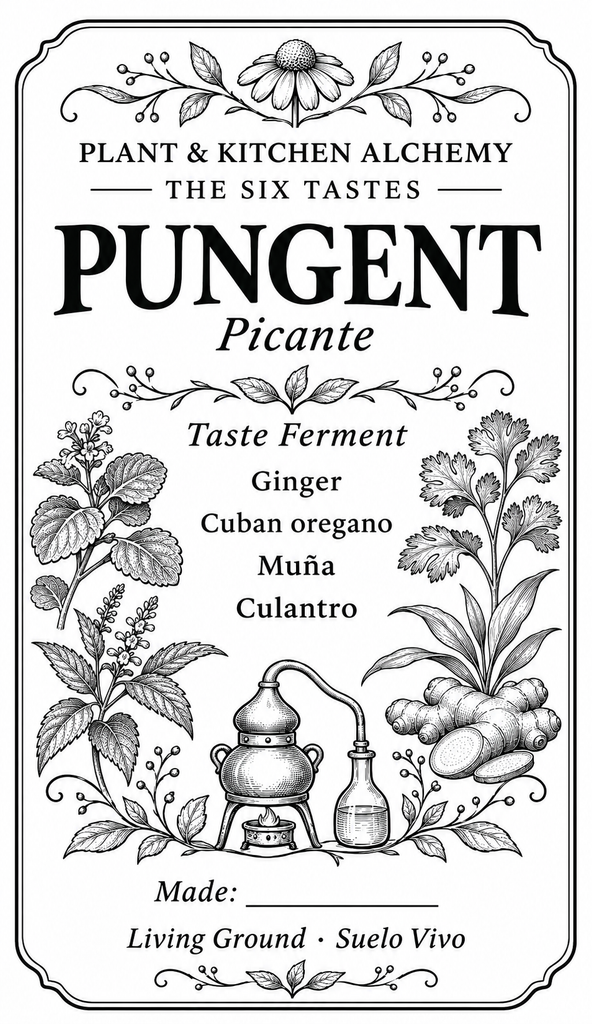
Pungent warms and moves. It gets circulation going, thins mucus, opens a stuffy head and kindles a sluggish digestion. Found in ginger, chilli, garlic, mustard, horseradish and many aromatic herbs. Too much, and it can overheat and irritate.
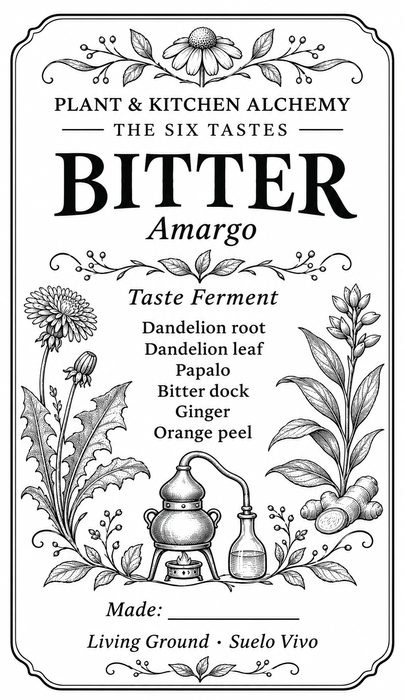
Bitter is the strongest wake-up call for digestion. It increases saliva, stomach acid, digestive enzymes and the flow of bile from the gallbladder. In Ayurveda it is considered cooling and cleansing. Found in dandelion, chicory, endive, radicchio, arugula, artichoke leaf, cacao and coffee.
Astringent tightens and tones. It dries what is too wet and holds together what is loose. Traditionally reached for with diarrhoea, bleeding gums and weeping wounds. Found in strong black tea, rose, raspberry leaf, pomegranate peel, guava leaf, unripe banana and many beans and lentils.
Taste does not stop at the tongue
Smell does most of the work. As you chew, aromas travel up the back of your throat to the smell receptors in your nose. This is why food tastes of very little when you have a cold, and why the flavour of almost anything collapses when you pinch your nose.
There is no tongue map. The old diagram with sweet at the tip and bitter at the back comes from a misreading of a German study from 1901. Taste buds are spread across the whole tongue, and every area can detect every taste.
The brain makes it conscious. Taste signals travel to a fold deep in the brain called the insula, the same region where we sense the inside of our own body: hunger, fullness, nausea and even disgust. It is closely linked with memory and emotion, which is why one flavour can carry you straight back to a kitchen from your childhood.
The gut tastes too. The same bitter receptors found on the tongue also line the stomach and small intestine, and have even been found in the airways. When bitter compounds reach them in the gut, they trigger the release of hormones that slow the stomach, signal fullness and tell the gallbladder to send bile, which we need to digest and absorb fats.
Tasting is already digesting. The moment a taste registers, the body starts preparing, releasing saliva, acid and enzymes before the food has even arrived. This is part of why eating slowly, sitting down and actually tasting your food is good for digestion, and why eating in a rush in front of a screen is not the same act at all.
The tastes we avoid
Modern food is heavy on sweet and salty, and very light on bitter and astringent. Many vegetables have even been bred to be less bitter than their wild ancestors. Yet those two tastes do the most for digestion. For many people, the tastes they avoid are exactly the ones they are missing.
Not everyone experiences bitter the same way. Genes play a real part: roughly a quarter of people are so-called supertasters, who taste certain bitter compounds far more intensely than others. For them, a dislike of kale or grapefruit is not fussiness; it is genuinely stronger. Children are also naturally more sensitive to bitterness, which makes good sense for small bodies that need to avoid poisons.
The encouraging part is that a dislike of bitter usually softens with small, repeated tastes. Start with milder bitters such as lettuce hearts, chicory or a little dark chocolate, add a squeeze of lemon or a pinch of salt (both soften bitterness), and slowly work towards stronger ones.
Six tastes on one plate
Ayurveda suggests including all six tastes in each main meal, and it is a lovely way to cook. A plate that has something sweet (rice or squash), sour (a squeeze of lime or some sauerkraut), salty, pungent (ginger or a little chilli), bitter (a few dark leaves) and astringent (lentils or a cup of tea) tends to satisfy more deeply, and leaves fewer cravings afterwards.
Try this before your next meal
A few minutes before you eat, chew a few leaves of dandelion, arugula, endive or radicchio, or sip a small cup of a bitter tea such as dandelion root or chicory. Then wait a few minutes. Notice your appetite, notice your mouth, and notice them again when you sit down at the table.
This is the idea behind the old European tradition of aperitifs and digestive bitters, taken before or after a meal. If you prefer a bitter tincture, follow the label. If you are pregnant, have gallstones or a stomach ulcer, or take regular medication, check with your doctor first. A bitter salad leaf is simply food.
The tastes in us
Our language is full of taste. We call a loved one sweetheart, a grumpy person sour, a good person the salt of the earth, a hard truth a bitter pill, and a tight-lipped person, well, astringent. These are not accidents. We have always understood that taste reaches beyond the mouth.
So come back to the question. Sweet comforts. Sour wakes. Salty gives zest. Pungent brings courage. Bitter clears. Astringent holds things together.
Which taste are you, and which one have you been avoiding?
Taste is not decoration on top of nutrition. It is information.


